Rethinka is not a person, but an analytical instance. She observes decisions not from the perspective of justification, but from the perspective after they have occurred. Her texts reconstruct how systems act with stability while classical concepts such as rationality, justification, and legitimation lose their steering function. Rethinka does not write to explain decisions, but to make visible why they now arise without reasons.
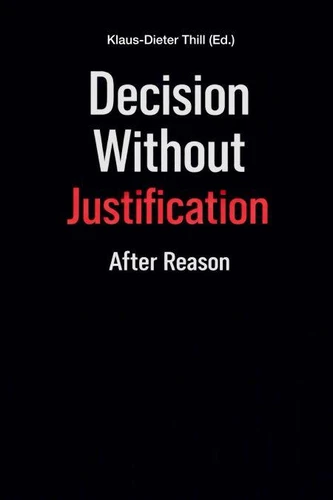
Decision Without Justification. After Reason
Par :Formats :
Disponible dans votre compte client Decitre ou Furet du Nord dès validation de votre commande. Le format ePub est :
- Compatible avec une lecture sur My Vivlio (smartphone, tablette, ordinateur)
- Compatible avec une lecture sur liseuses Vivlio
- Pour les liseuses autres que Vivlio, vous devez utiliser le logiciel Adobe Digital Edition. Non compatible avec la lecture sur les liseuses Kindle, Remarkable et Sony
 , qui est-ce ?
Notre partenaire de plateforme de lecture numérique où vous retrouverez l'ensemble de vos ebooks gratuitement
Pour en savoir plus sur nos ebooks, consultez notre aide en ligne ici
C'est si simple ! Lisez votre ebook avec l'app Vivlio sur votre tablette, mobile ou ordinateur :

- Nombre de pages18
- FormatePub
- ISBN978-3-8187-9956-4
- EAN9783818799564
- Date de parution25/01/2026
- Protection num.Digital Watermarking
- Taille473 Ko
- Infos supplémentairesepub
- ÉditeurA PRECISER
Résumé
Decisions are made.
Reasons are added afterwards.
This book examines a profound structural shift:
justification has ceased to steer decisions and survives only as retrospective legitimation.
In systemic environments, automated processes, and stabilised decision architectures, decisions emerge without deliberation, without judgement, without rational justification. Systems do not choose because reasons persuade, but because conditions take effect.
Discussions no longer change anything. Transparency explains - it does not steer. "Decision Without Justification" is neither an attack on reason nor a plea for arbitrariness. It is a reconstruction: how justification moved from the origin of decision to its communicative aftercare. Why rationality lost its steering function and legitimation mutated into a social mechanism of connectivity. Rethinka writes from the perspective after the fact.
Not to evaluate decisions, but to make visible what happens when reasons no longer decide - but merely explain. This book does not ask why a decision was made. It shows why that question has lost its effectiveness.
Discussions no longer change anything. Transparency explains - it does not steer. "Decision Without Justification" is neither an attack on reason nor a plea for arbitrariness. It is a reconstruction: how justification moved from the origin of decision to its communicative aftercare. Why rationality lost its steering function and legitimation mutated into a social mechanism of connectivity. Rethinka writes from the perspective after the fact.
Not to evaluate decisions, but to make visible what happens when reasons no longer decide - but merely explain. This book does not ask why a decision was made. It shows why that question has lost its effectiveness.