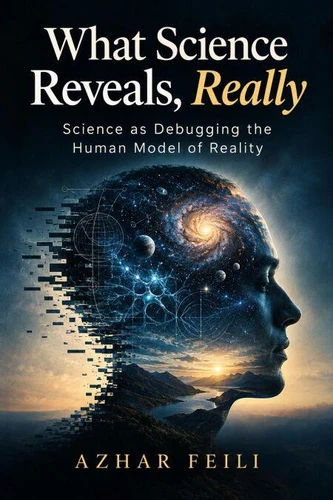
What if everything we think we know about science is backwards?We're taught that science reveals truth-that it's a lamp slowly illuminating the darkness of our ignorance. But look closely at any scientific revolution, and you'll find something different at its center: not a discovery, but a correction. Not a new fact, but the exposure of an old mistake. In this provocative and deeply original work, Azhar Feili argues that science is not a truth-finding enterprise at all.
It is a debugging process-a long, painstaking effort to identify and correct the errors in a cognitive operating system that was never designed to see the world as it actually is. The human brain is a survival engine, not a truth engine. It shipped with factory settings-perceptual shortcuts, causal assumptions, an entire unquestioned cosmology-that worked beautifully on the ancestral savannah but break down catastrophically when we build instruments powerful enough to carry us beyond it.
What we call science is the history of those breakdowns, and the patches we've written in response. Drawing on physics, neuroscience, evolution, and philosophy, What Science Reveals, Really takes you on a mind-bending journey through: The Brain's Factory Settings - How space, time, solidity, causality, and the self are cognitive constructions, not readings of reality Instruments as Error Generators - Why the telescope, microscope, and particle detector didn't reveal truth but subtracted certainty The Architecture Problem - Why some truths may be permanently unthinkable for human minds Reality vs.
Model - The distinction we keep collapsing, and why it matters The Multidimensional Blindness Hypothesis - What if we're all ticks, unaware of the galaxies? The Locality of Value - If the universe doesn't care, why meaning is still real-and more precious than ever This book will change how you see everything. Not because it offers final answers-it explicitly rejects that possibility. But because it reveals something deeper: we can discover our own limits.
We can debug our own perception. We can recognize that our first truths were small, and that our current truths will look small to those who come after. The most dangerous bugs are the ones that feel like facts. What Science Reveals, Really is not a counsel of despair. It is an invitation to a stance of radical openness combined with full commitment-curiosity without the demand for final answers, humility without paralysis, and the recognition that meaning, though local and fragile, is nonetheless real.
The universe does not need you to matter. You matter anyway. Perfect for readers of: Sapiens by Yuval Noah Harari Thinking, Fast and Slow by Daniel Kahneman The Beginning of Infinity by David Deutsch Why Evolution Is True by Jerry Coyne The Case Against Reality by Donald Hoffman
What if everything we think we know about science is backwards?We're taught that science reveals truth-that it's a lamp slowly illuminating the darkness of our ignorance. But look closely at any scientific revolution, and you'll find something different at its center: not a discovery, but a correction. Not a new fact, but the exposure of an old mistake. In this provocative and deeply original work, Azhar Feili argues that science is not a truth-finding enterprise at all.
It is a debugging process-a long, painstaking effort to identify and correct the errors in a cognitive operating system that was never designed to see the world as it actually is. The human brain is a survival engine, not a truth engine. It shipped with factory settings-perceptual shortcuts, causal assumptions, an entire unquestioned cosmology-that worked beautifully on the ancestral savannah but break down catastrophically when we build instruments powerful enough to carry us beyond it.
What we call science is the history of those breakdowns, and the patches we've written in response. Drawing on physics, neuroscience, evolution, and philosophy, What Science Reveals, Really takes you on a mind-bending journey through: The Brain's Factory Settings - How space, time, solidity, causality, and the self are cognitive constructions, not readings of reality Instruments as Error Generators - Why the telescope, microscope, and particle detector didn't reveal truth but subtracted certainty The Architecture Problem - Why some truths may be permanently unthinkable for human minds Reality vs.
Model - The distinction we keep collapsing, and why it matters The Multidimensional Blindness Hypothesis - What if we're all ticks, unaware of the galaxies? The Locality of Value - If the universe doesn't care, why meaning is still real-and more precious than ever This book will change how you see everything. Not because it offers final answers-it explicitly rejects that possibility. But because it reveals something deeper: we can discover our own limits.
We can debug our own perception. We can recognize that our first truths were small, and that our current truths will look small to those who come after. The most dangerous bugs are the ones that feel like facts. What Science Reveals, Really is not a counsel of despair. It is an invitation to a stance of radical openness combined with full commitment-curiosity without the demand for final answers, humility without paralysis, and the recognition that meaning, though local and fragile, is nonetheless real.
The universe does not need you to matter. You matter anyway. Perfect for readers of: Sapiens by Yuval Noah Harari Thinking, Fast and Slow by Daniel Kahneman The Beginning of Infinity by David Deutsch Why Evolution Is True by Jerry Coyne The Case Against Reality by Donald Hoffman