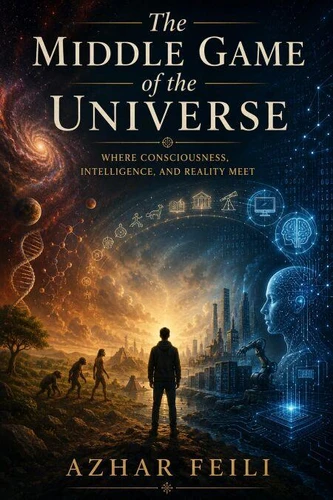
Your Self Is Not What You Think It IsWhat if you are not a thing that moves through time, but a process?Human beings are obsessed with beginnings and endings. We celebrate birth, fear death, and imagine existence as a line from one boundary to another. But the universe itself may not be interested in boundaries-only in what happens between them. The Middle Game of the Universe challenges our most fundamental assumptions about who we are.
Drawing on philosophy, evolutionary science, and the emergence of artificial intelligence, it explores: Why the self is best understood as a continuing process, not a permanent object How birth is the beginning of a particular arrangement-not the beginning of what that arrangement is made from Why identity can survive through transformation and even branching How consciousness, like a whirlpool or a flame, may be a pattern that persists while its components change What it would mean for a self to fork, mix, or recombine with other informational structures Whether intelligence itself could eventually become a property of the universe, not just of individual beings This is not a book of easy answers.
It is an invitation to think differently-about yourself, about consciousness, about intelligence, and about the extraordinary process that produced them all. The universe has spent billions of years producing arrangements capable of asking questions. Now one of those arrangements is asking questions about the process that produced it. That is where this book begins.
Your Self Is Not What You Think It IsWhat if you are not a thing that moves through time, but a process?Human beings are obsessed with beginnings and endings. We celebrate birth, fear death, and imagine existence as a line from one boundary to another. But the universe itself may not be interested in boundaries-only in what happens between them. The Middle Game of the Universe challenges our most fundamental assumptions about who we are.
Drawing on philosophy, evolutionary science, and the emergence of artificial intelligence, it explores: Why the self is best understood as a continuing process, not a permanent object How birth is the beginning of a particular arrangement-not the beginning of what that arrangement is made from Why identity can survive through transformation and even branching How consciousness, like a whirlpool or a flame, may be a pattern that persists while its components change What it would mean for a self to fork, mix, or recombine with other informational structures Whether intelligence itself could eventually become a property of the universe, not just of individual beings This is not a book of easy answers.
It is an invitation to think differently-about yourself, about consciousness, about intelligence, and about the extraordinary process that produced them all. The universe has spent billions of years producing arrangements capable of asking questions. Now one of those arrangements is asking questions about the process that produced it. That is where this book begins.