OFFRE LISEUSES
Une liseuse achetée = une housse offerte* jusqu'au 21 juin
- Accueil /
- Azhar Feili
Azhar Feili

Dernière sortie
The Waterfall and the Word
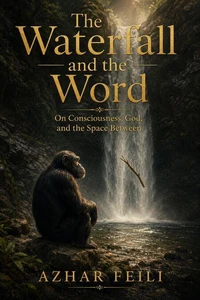
A chimpanzee stands before a waterfall. She sways, throws a branch into the cascade, then sits in silence and stares. For a long time, she simply stares. She is not praying. But she is not merely watching water fall, either. Something is happening in her that we do not have a precise word for - something between instinct and wonder, between sensation and meaning. The Waterfall and the Word begins with that image and follows the question it raises all the way to its conclusion: how did wonder become God?Drawing on neuroscience, evolutionary biology, developmental psychology, and the history of religion, this book traces a single thread through the full spectrum of consciousness - from the reptile's pure, immediate sentience, through the mammal's rich social and emotional life, to the uniquely human capacity to ask why - and not stop until an answer is found.
Along the way, it examines what happens to a human being raised in complete isolation - what the self becomes when no one witnesses it. It looks at the hard evidence from feral children, Romanian orphanages, and the neuroscience of attachment. It asks whether the concept of God could survive without language - and concludes, precisely, that it cannot. And it shows why the first great civilizations - Persian, Egyptian, Indian - each built their religion around a different one of the three questions that a self-aware consciousness cannot silence: How should I behave? What happens when I die? Where did everything come from?The argument is not for God or against God.
It is something rarer: a clear-eyed account of why the concept of God is not an accident, not a primitive error, but a remarkably precise answer to the precise problems posed by the kind of consciousness evolution produced in human beings. Accessible, philosophically rigorous, and written with quiet urgency, The Waterfall and the Word is for anyone who has stood somewhere vast and felt something they could not name - and wanted to understand what that feeling is, where it comes from, and why it has driven human civilization since the beginning.
The sacred is not in the world. It is in what happens when the right kind of mind meets the world. This book maps that meeting.
Along the way, it examines what happens to a human being raised in complete isolation - what the self becomes when no one witnesses it. It looks at the hard evidence from feral children, Romanian orphanages, and the neuroscience of attachment. It asks whether the concept of God could survive without language - and concludes, precisely, that it cannot. And it shows why the first great civilizations - Persian, Egyptian, Indian - each built their religion around a different one of the three questions that a self-aware consciousness cannot silence: How should I behave? What happens when I die? Where did everything come from?The argument is not for God or against God.
It is something rarer: a clear-eyed account of why the concept of God is not an accident, not a primitive error, but a remarkably precise answer to the precise problems posed by the kind of consciousness evolution produced in human beings. Accessible, philosophically rigorous, and written with quiet urgency, The Waterfall and the Word is for anyone who has stood somewhere vast and felt something they could not name - and wanted to understand what that feeling is, where it comes from, and why it has driven human civilization since the beginning.
The sacred is not in the world. It is in what happens when the right kind of mind meets the world. This book maps that meeting.
A chimpanzee stands before a waterfall. She sways, throws a branch into the cascade, then sits in silence and stares. For a long time, she simply stares. She is not praying. But she is not merely watching water fall, either. Something is happening in her that we do not have a precise word for - something between instinct and wonder, between sensation and meaning. The Waterfall and the Word begins with that image and follows the question it raises all the way to its conclusion: how did wonder become God?Drawing on neuroscience, evolutionary biology, developmental psychology, and the history of religion, this book traces a single thread through the full spectrum of consciousness - from the reptile's pure, immediate sentience, through the mammal's rich social and emotional life, to the uniquely human capacity to ask why - and not stop until an answer is found.
Along the way, it examines what happens to a human being raised in complete isolation - what the self becomes when no one witnesses it. It looks at the hard evidence from feral children, Romanian orphanages, and the neuroscience of attachment. It asks whether the concept of God could survive without language - and concludes, precisely, that it cannot. And it shows why the first great civilizations - Persian, Egyptian, Indian - each built their religion around a different one of the three questions that a self-aware consciousness cannot silence: How should I behave? What happens when I die? Where did everything come from?The argument is not for God or against God.
It is something rarer: a clear-eyed account of why the concept of God is not an accident, not a primitive error, but a remarkably precise answer to the precise problems posed by the kind of consciousness evolution produced in human beings. Accessible, philosophically rigorous, and written with quiet urgency, The Waterfall and the Word is for anyone who has stood somewhere vast and felt something they could not name - and wanted to understand what that feeling is, where it comes from, and why it has driven human civilization since the beginning.
The sacred is not in the world. It is in what happens when the right kind of mind meets the world. This book maps that meeting.
Along the way, it examines what happens to a human being raised in complete isolation - what the self becomes when no one witnesses it. It looks at the hard evidence from feral children, Romanian orphanages, and the neuroscience of attachment. It asks whether the concept of God could survive without language - and concludes, precisely, that it cannot. And it shows why the first great civilizations - Persian, Egyptian, Indian - each built their religion around a different one of the three questions that a self-aware consciousness cannot silence: How should I behave? What happens when I die? Where did everything come from?The argument is not for God or against God.
It is something rarer: a clear-eyed account of why the concept of God is not an accident, not a primitive error, but a remarkably precise answer to the precise problems posed by the kind of consciousness evolution produced in human beings. Accessible, philosophically rigorous, and written with quiet urgency, The Waterfall and the Word is for anyone who has stood somewhere vast and felt something they could not name - and wanted to understand what that feeling is, where it comes from, and why it has driven human civilization since the beginning.
The sacred is not in the world. It is in what happens when the right kind of mind meets the world. This book maps that meeting.
Les livres de Azhar Feili

5,49 €


5,49 €

5,49 €

5,49 €

5,49 €

5,49 €

5,49 €

5,49 €

5,99 €

5,49 €

5,49 €

5,49 €

5,49 €

5,49 €

5,49 €