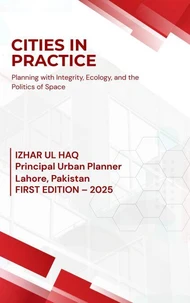
Cities are not just built environments; they are living archives of resilience, culture, and human aspiration. This book documents Pakistan's urban and regional journey, situating local realities within global debates on sustainability, resilience, and ethics in development. It is part of a broader mission: to build a legacy archive of ideas and frameworks for future generations. Pakistan's cities-Lahore, Karachi, Islamabad, and beyond-illustrate the complexity of rapid urbanization.
Transport hubs here are not surrounded by vacant land awaiting redevelopment, but by dense neighborhoods, bustling bazaars, and informal settlements that have grown organically over decades. Courtyards, mohallas, and chowks remain central to social life even as metro lines and bus rapid transit systems weave through the city fabric. The challenges of density, informality, and climate vulnerability resonate with cities across Africa and Asia, making Pakistan's experience a contribution to a shared global conversation.
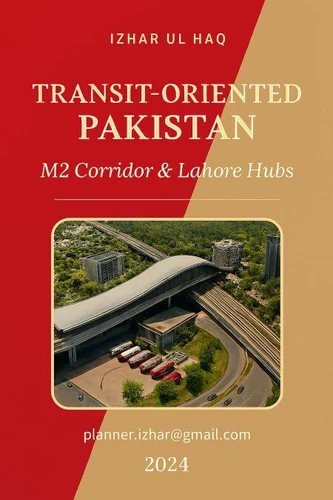
A central theme of this book is Transit-Oriented Development (TOD). For Pakistan, where rising car dependency and rapid population growth pose significant challenges, TOD offers a strategic pathway toward sustainable and inclusive growth. The book explores TOD potential in two critical contexts: Service areas along the M2 Motorway, connecting Lahore and Islamabad. Major transit terminals in Lahore, embedded within dense urban fabric.
Through case studies such as the Orange Line Metro Train in Lahore and the evolving master plans of Karachi, the book demonstrates how TOD can transform motorway service areas into vibrant, mixed-use nodes and adapt dense urban terminals into walkable, resilient communities. It outlines phased development strategies, financing models, and governance reforms, while emphasizing social inclusion, affordable housing, and climate resilience.
International comparisons-from Hong Kong's MTR model to Arlington's suburban revitalization, Portland's phased redevelopment, Copenhagen's cycling culture, and Singapore's MRT hubs-highlight lessons Pakistan can adapt. These examples underscore the importance of integrating property development with transit, reforming zoning laws, embedding sustainability measures, and fostering community buy-in through awareness campaigns.
The book also emphasizes the environmental and economic benefits of TOD: reduced car dependence, lower emissions, healthier communities, and new opportunities in retail, hospitality, and logistics. By embedding green infrastructure, renewable energy, and climate-resilient design, TOD becomes not only a framework for mobility but also a vehicle for ecological stewardship and innovation. Ultimately, this work is not about expansion for its own sake.
It is about continuity and legacy-recording, reflecting, and sharing insights that transcend borders. Pakistan's urban journey, with all its challenges and creativity, becomes part of a global archive of knowledge. For planners, architects, policymakers, and citizens, this book offers both a mirror of local realities and a window into global possibilities. It is a call to adapt, endure, and thrive-ensuring that cities remain living archives for generations to come.
Cities are not just built environments; they are living archives of resilience, culture, and human aspiration. This book documents Pakistan's urban and regional journey, situating local realities within global debates on sustainability, resilience, and ethics in development. It is part of a broader mission: to build a legacy archive of ideas and frameworks for future generations. Pakistan's cities-Lahore, Karachi, Islamabad, and beyond-illustrate the complexity of rapid urbanization.
Transport hubs here are not surrounded by vacant land awaiting redevelopment, but by dense neighborhoods, bustling bazaars, and informal settlements that have grown organically over decades. Courtyards, mohallas, and chowks remain central to social life even as metro lines and bus rapid transit systems weave through the city fabric. The challenges of density, informality, and climate vulnerability resonate with cities across Africa and Asia, making Pakistan's experience a contribution to a shared global conversation.
A central theme of this book is Transit-Oriented Development (TOD). For Pakistan, where rising car dependency and rapid population growth pose significant challenges, TOD offers a strategic pathway toward sustainable and inclusive growth. The book explores TOD potential in two critical contexts: Service areas along the M2 Motorway, connecting Lahore and Islamabad. Major transit terminals in Lahore, embedded within dense urban fabric.
Through case studies such as the Orange Line Metro Train in Lahore and the evolving master plans of Karachi, the book demonstrates how TOD can transform motorway service areas into vibrant, mixed-use nodes and adapt dense urban terminals into walkable, resilient communities. It outlines phased development strategies, financing models, and governance reforms, while emphasizing social inclusion, affordable housing, and climate resilience.
International comparisons-from Hong Kong's MTR model to Arlington's suburban revitalization, Portland's phased redevelopment, Copenhagen's cycling culture, and Singapore's MRT hubs-highlight lessons Pakistan can adapt. These examples underscore the importance of integrating property development with transit, reforming zoning laws, embedding sustainability measures, and fostering community buy-in through awareness campaigns.
The book also emphasizes the environmental and economic benefits of TOD: reduced car dependence, lower emissions, healthier communities, and new opportunities in retail, hospitality, and logistics. By embedding green infrastructure, renewable energy, and climate-resilient design, TOD becomes not only a framework for mobility but also a vehicle for ecological stewardship and innovation. Ultimately, this work is not about expansion for its own sake.
It is about continuity and legacy-recording, reflecting, and sharing insights that transcend borders. Pakistan's urban journey, with all its challenges and creativity, becomes part of a global archive of knowledge. For planners, architects, policymakers, and citizens, this book offers both a mirror of local realities and a window into global possibilities. It is a call to adapt, endure, and thrive-ensuring that cities remain living archives for generations to come.

 , qui est-ce ?