
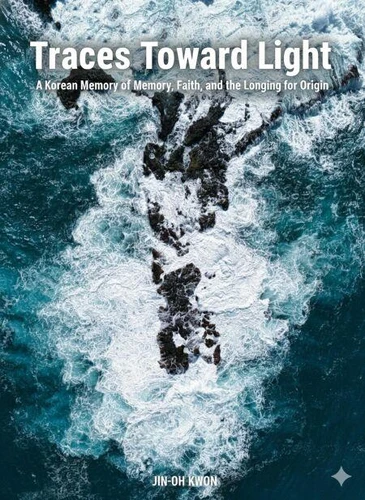
Traces Toward Light
Par :Formats :
Disponible dans votre compte client Decitre ou Furet du Nord dès validation de votre commande. Le format ePub est :
- Compatible avec une lecture sur My Vivlio (smartphone, tablette, ordinateur)
- Compatible avec une lecture sur liseuses Vivlio
- Pour les liseuses autres que Vivlio, vous devez utiliser le logiciel Adobe Digital Edition. Non compatible avec la lecture sur les liseuses Kindle, Remarkable et Sony
 , qui est-ce ?
Notre partenaire de plateforme de lecture numérique où vous retrouverez l'ensemble de vos ebooks gratuitement
Pour en savoir plus sur nos ebooks, consultez notre aide en ligne ici
C'est si simple ! Lisez votre ebook avec l'app Vivlio sur votre tablette, mobile ou ordinateur :

- FormatePub
- ISBN8223807322
- EAN9798223807322
- Date de parution19/01/2026
- Protection num.pas de protection
- Infos supplémentairesepub
- ÉditeurDraft2Digital
Résumé
"Traces Toward Light: A Korean Memoir of Memory, Faith, and the Longing for Origin" is a profound and lyrical spiritual autobiography by Mukmyeong (Silent Light), the pen name of Kwon Jin-oh. More than a simple memoir, it is a contemplative journey that weaves together personal history, philosophical inquiry, and a radical reimagining of faith, tracing the author's path from the specific landscapes of Korea to a universal search for belonging and divine order.
The book opens with a prologue that frames the entire work not as a linear report of events, but as a map of memory and contemplation. The author describes writing as casting a stone into the still waters of the past, creating ripples where faces, voices, and fragments of faith resurface. This sets the tone for a narrative where time is fluid-a resonant space where past and present engage in continuous dialogue, and where everyday experiences crystallize into lasting philosophy.
The narrative is divided into four thematically rich parts:Part 1: The Seaside and the Bench explores consciousness and memory through poignant vignettes. In "A Seat Facing the Sea, " a bus stop bench in Seoul triggers a vivid memory of a donated memorial bench on Seattle's Carkeek Beach. This experience becomes a meditation on how consciousness can transcend time and matter, connecting the author to the lives of a long-departed couple and framing all humans as "quantum observers" briefly passing through each other's existences.
"The Purification of Memory" reframes the fading of memory not as loss, but as a necessary emptying that allows one to return to a more fundamental state of being, where faith exists before theology and life is lived sincerely in each moment. Part 2: A Time to Return delves into themes of loss, absence, and forward motion. "A Person with No Time to Return" is a striking confession of having no idealized past to long for.
This lack becomes not a poverty, but a defining characteristic that compels a life oriented solely toward the future-a lonely yet clear-eyed pilgrimage toward a "home" that lies ahead, not behind. "The Autumn of the Stella" is a warmly nostalgic yet bittersweet recollection of youthful recklessness and enduring friendship, centered on a forbidden drive in a friend's new car in 1983. The episode captures the beauty of fragile, illegal moments and examines how such shared memories bind people together across decades.....
The book opens with a prologue that frames the entire work not as a linear report of events, but as a map of memory and contemplation. The author describes writing as casting a stone into the still waters of the past, creating ripples where faces, voices, and fragments of faith resurface. This sets the tone for a narrative where time is fluid-a resonant space where past and present engage in continuous dialogue, and where everyday experiences crystallize into lasting philosophy.
The narrative is divided into four thematically rich parts:Part 1: The Seaside and the Bench explores consciousness and memory through poignant vignettes. In "A Seat Facing the Sea, " a bus stop bench in Seoul triggers a vivid memory of a donated memorial bench on Seattle's Carkeek Beach. This experience becomes a meditation on how consciousness can transcend time and matter, connecting the author to the lives of a long-departed couple and framing all humans as "quantum observers" briefly passing through each other's existences.
"The Purification of Memory" reframes the fading of memory not as loss, but as a necessary emptying that allows one to return to a more fundamental state of being, where faith exists before theology and life is lived sincerely in each moment. Part 2: A Time to Return delves into themes of loss, absence, and forward motion. "A Person with No Time to Return" is a striking confession of having no idealized past to long for.
This lack becomes not a poverty, but a defining characteristic that compels a life oriented solely toward the future-a lonely yet clear-eyed pilgrimage toward a "home" that lies ahead, not behind. "The Autumn of the Stella" is a warmly nostalgic yet bittersweet recollection of youthful recklessness and enduring friendship, centered on a forbidden drive in a friend's new car in 1983. The episode captures the beauty of fragile, illegal moments and examines how such shared memories bind people together across decades.....
A propos de JIN OH KWON

1,99 €

The Bread of the Poor
E-book
2,49 €

The Unsevered Sky
E-book
1,49 €
1,99 €
1,99 €

Sphex
E-book
1,99 €
1,99 €

Call Him Israel
E-book
1,99 €
The Gravity of Choice
E-book
1,99 €
1,99 €

Three Shadows
E-book
1,99 €

1,49 €
1,49 €


Return to the Light
E-book
1,49 €