
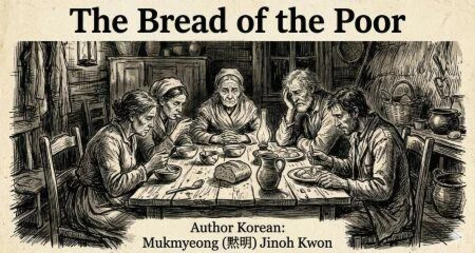
The Bread of the Poor
Par :Formats :
Disponible dans votre compte client Decitre ou Furet du Nord dès validation de votre commande. Le format ePub est :
- Compatible avec une lecture sur My Vivlio (smartphone, tablette, ordinateur)
- Compatible avec une lecture sur liseuses Vivlio
- Pour les liseuses autres que Vivlio, vous devez utiliser le logiciel Adobe Digital Edition. Non compatible avec la lecture sur les liseuses Kindle, Remarkable et Sony
 , qui est-ce ?
Notre partenaire de plateforme de lecture numérique où vous retrouverez l'ensemble de vos ebooks gratuitement
Pour en savoir plus sur nos ebooks, consultez notre aide en ligne ici
C'est si simple ! Lisez votre ebook avec l'app Vivlio sur votre tablette, mobile ou ordinateur :

- FormatePub
- ISBN8232452667
- EAN9798232452667
- Date de parution28/02/2026
- Protection num.pas de protection
- Infos supplémentairesepub
- ÉditeurDraft2Digital
Résumé
The Bread of the Poor: A Novel SummaryAuthor: Mukmyeong (??) Jinoh KwonOverviewThe Bread of the Poor is a profound philosophical novel exploring trauma, violence, love, and the ethics of consumption through the intersecting lives of two damaged neighbors and a rescued dog. Set in contemporary Korea, the story uses the humble bowl of bosintang (dog meat soup) as a gateway to examine humanity's deepest contradictions.
Plot SummaryPart 1: The WoundedJin-woo is a man shattered by a near-fatal car accident. His body was reconstructed, but his soul remains fractured. He finds himself unable to fully inhabit his own life-until he discovers bosintang. The rich, primal broth rekindles a spark of life within him, becoming an anchor against his drifting agony. He eats dog meat not out of cruelty, but as a desperate ritual of survival.
Yet, he paradoxically feels tenderness toward dogs on the street, a contradiction he smooths over with cultural justifications. Next door lives Hye-soon, a cosmetics counter manager whose polished exterior masks deep wounds. Abandoned by a lover who left only a Welsh Corgi as a living reminder of his betrayal, she displaces her pain onto the helpless creature. Night after night, Jin-woo hears the sounds of violence through the thin walls-the dog's whimpers, the thud of blows.
Part 2: The ThresholdWhen Jin-woo finally confronts Hye-soon, she throws his hypocrisy back at him: "You eat them, don't you? How can you play the protector when you have the taste of them on your tongue?" Her logic cuts deep. He argues, "I eat to survive. You strike to destroy." But the question haunts him: Where is the line between killing for sustenance and striking for malice?Their shared darkness becomes an unexpected bridge.
Jin-woo learns that Hye-soon's violence stems from isolation and betrayal-a distorted way of passing her agony onto a being that cannot fight back. He recognizes the same mechanism within himself: both are displacing internal rot onto the vulnerable. Part 3: The CrossingIn a pivotal moment, Jin-woo takes the dog. Not through force, but by leaving his door open and allowing the trembling creature to cross the threshold on its own four feet.
The dog's gaze-filled not with shock but with the haunting familiarity of one for whom pain has become predictable-dismantles all of Jin-woo's justifications. Hye-soon begins visiting under the pretext of "checking on the dog." Through these quiet encounters, they witness each other's wounds. Jin-woo's body still hums with chronic pain; Hye-soon's hands slowly transform from instruments of violence to vessels of hesitant tenderness.
They become lovers-not through grand passion, but as two shipwreck survivors huddling for warmth. ConclusionThe novel rejects easy redemption. Jin-woo and Hye-soon do not "save" each other. They simply refuse to run away. They learn that love is not a rescue mission but a daily choice-a humble, repetitive commitment to try again. As Jin-woo reflects: "Some people love like the rich man-consuming in gluttonous quantities.
But the love of the poor is different. It divides the last crust of bread, bit by bit, day by day. That is the love that lasts."Themes: Trauma and healing, violence and its cycles, the ethics of consumption, salvation versus maintenance, the weight of responsibility, love as endurance rather than acquisition."They are still alive. Sometimes they hurt, and sometimes they stumble. But every morning, they rise, and they do not run away.
That is all. And it is more than enough."
Plot SummaryPart 1: The WoundedJin-woo is a man shattered by a near-fatal car accident. His body was reconstructed, but his soul remains fractured. He finds himself unable to fully inhabit his own life-until he discovers bosintang. The rich, primal broth rekindles a spark of life within him, becoming an anchor against his drifting agony. He eats dog meat not out of cruelty, but as a desperate ritual of survival.
Yet, he paradoxically feels tenderness toward dogs on the street, a contradiction he smooths over with cultural justifications. Next door lives Hye-soon, a cosmetics counter manager whose polished exterior masks deep wounds. Abandoned by a lover who left only a Welsh Corgi as a living reminder of his betrayal, she displaces her pain onto the helpless creature. Night after night, Jin-woo hears the sounds of violence through the thin walls-the dog's whimpers, the thud of blows.
Part 2: The ThresholdWhen Jin-woo finally confronts Hye-soon, she throws his hypocrisy back at him: "You eat them, don't you? How can you play the protector when you have the taste of them on your tongue?" Her logic cuts deep. He argues, "I eat to survive. You strike to destroy." But the question haunts him: Where is the line between killing for sustenance and striking for malice?Their shared darkness becomes an unexpected bridge.
Jin-woo learns that Hye-soon's violence stems from isolation and betrayal-a distorted way of passing her agony onto a being that cannot fight back. He recognizes the same mechanism within himself: both are displacing internal rot onto the vulnerable. Part 3: The CrossingIn a pivotal moment, Jin-woo takes the dog. Not through force, but by leaving his door open and allowing the trembling creature to cross the threshold on its own four feet.
The dog's gaze-filled not with shock but with the haunting familiarity of one for whom pain has become predictable-dismantles all of Jin-woo's justifications. Hye-soon begins visiting under the pretext of "checking on the dog." Through these quiet encounters, they witness each other's wounds. Jin-woo's body still hums with chronic pain; Hye-soon's hands slowly transform from instruments of violence to vessels of hesitant tenderness.
They become lovers-not through grand passion, but as two shipwreck survivors huddling for warmth. ConclusionThe novel rejects easy redemption. Jin-woo and Hye-soon do not "save" each other. They simply refuse to run away. They learn that love is not a rescue mission but a daily choice-a humble, repetitive commitment to try again. As Jin-woo reflects: "Some people love like the rich man-consuming in gluttonous quantities.
But the love of the poor is different. It divides the last crust of bread, bit by bit, day by day. That is the love that lasts."Themes: Trauma and healing, violence and its cycles, the ethics of consumption, salvation versus maintenance, the weight of responsibility, love as endurance rather than acquisition."They are still alive. Sometimes they hurt, and sometimes they stumble. But every morning, they rise, and they do not run away.
That is all. And it is more than enough."
A propos de JIN OH KWON

1,99 €

The Unsevered Sky
E-book
1,49 €

1,99 €

1,99 €

Sphex
E-book
1,99 €
1,99 €
Call Him Israel
E-book
1,99 €
The Gravity of Choice
E-book
1,99 €

1,99 €

Three Shadows
E-book
1,99 €


1,49 €
1,49 €

Return to the Light
E-book
1,49 €