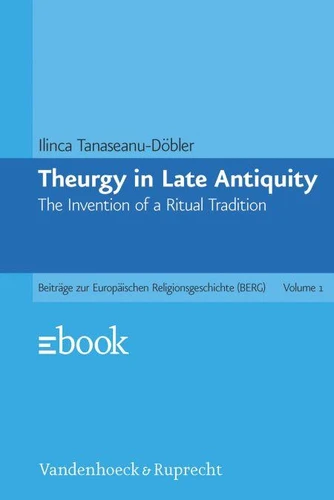
Theurgy in Late Antiquity. The Invention of a Ritual Tradition
Par :Formats :
Disponible dans votre compte client Decitre ou Furet du Nord dès validation de votre commande. Le format PDF est :
- Compatible avec une lecture sur My Vivlio (smartphone, tablette, ordinateur)
- Compatible avec une lecture sur liseuses Vivlio
- Pour les liseuses autres que Vivlio, vous devez utiliser le logiciel Adobe Digital Edition. Non compatible avec la lecture sur les liseuses Kindle, Remarkable et Sony
 , qui est-ce ?
Notre partenaire de plateforme de lecture numérique où vous retrouverez l'ensemble de vos ebooks gratuitement
Pour en savoir plus sur nos ebooks, consultez notre aide en ligne ici
C'est si simple ! Lisez votre ebook avec l'app Vivlio sur votre tablette, mobile ou ordinateur :

- Nombre de pages325
- FormatPDF
- ISBN978-3-647-54020-7
- EAN9783647540207
- Date de parution15/05/2013
- Protection num.pas de protection
- Taille3 Mo
- Infos supplémentairespdf
- ÉditeurVandenhoeck & Ruprecht
Résumé
Theurgy is commonly taken to denote a complex of rites which are based on the so-called Chaldean Oracles, a collection of oracles in hexameters, which were probably composed during the late 2nd century AD. These rituals are mostly known through Neoplatonic sources, who engage in a passionate debate about their relevance to the salvation of the soul and thus to the philosopher's ultimate goal. Ilinca Tanaseanu-Döbler examines the development of the discourse on theurgy, attempting to reconstruct what was understood as theurgic ritual in the late antique sources.
Withstanding the temptation to impose a unity on the disparate sources which span several centuries, she thus goes beyond the picture of a coherent, extra-philosophical tradition drawn by the Neoplatonists to sketch the variations in the rituals subsumed under 'theurgy' and their function, and shows how every author constructs his own 'theurgy'. This perspective leads to consider theurgy as an example of an 'artificial' ritual tradition, composed from already existing elements to create something claimed as sui generis.
Theurgy offers the great opportunity to look at such a tradition from its beginning up to its end and to analyse the mechanisms of inventing and reinventing such a ritual tradition in process.
Withstanding the temptation to impose a unity on the disparate sources which span several centuries, she thus goes beyond the picture of a coherent, extra-philosophical tradition drawn by the Neoplatonists to sketch the variations in the rituals subsumed under 'theurgy' and their function, and shows how every author constructs his own 'theurgy'. This perspective leads to consider theurgy as an example of an 'artificial' ritual tradition, composed from already existing elements to create something claimed as sui generis.
Theurgy offers the great opportunity to look at such a tradition from its beginning up to its end and to analyse the mechanisms of inventing and reinventing such a ritual tradition in process.