There was a day when the streets were kept safe by the likes of Dick Tracy, Marlowe, the Hardy Boys, and Hercule Peroit. For readers who grew up with them, it's sad to see what these sleuths' turf has become. If you're growing tired of books, movies, and music that bombards you with sex, blood & gore, and graphic violence, there's hope on the horizon. Meet Eddie Rourke. An Irish immigrant in his late 60s, who fled Dublin and its flawed police system to pursue a new life in America.
Now an old-school gumshoe private investigator, living in a gritty Uptown Chicago neighborhood, he is comfortable wearing a trenchcoat, fedora, a necktie loose at the neck, and a five o'clock shadow. Eddie is a perpetual outsider. He understands the streets, but he views American corruption through a unique, cynical lens. His office is in a fading downtown commercial building above a neon-lit jazz club.
Think brick alleyways, fire escapes, and the constant rumble of the elevated "L" train rattling his windows. The room, which doubles as an apartment, is heavy with the scent of Chesterfields, stale coffee, and wet asphalt from the window he keeps cracked. The frosted glass door reads E. Rourke - Private Investigations. A calendar from an Irish-American funeral home hangs on the wall. Sitting on his desk is a heavy black Western Electric rotary phone and a boxy Smith-Corona typewriter.
These are the stories of the cases of Eddie Rourke. As varied as the man, he turns up involved in some of the most unexpected cases, but with a fierce Irish tenacity, he won't stop until he has all the answers, putting the offending parties behind bars.
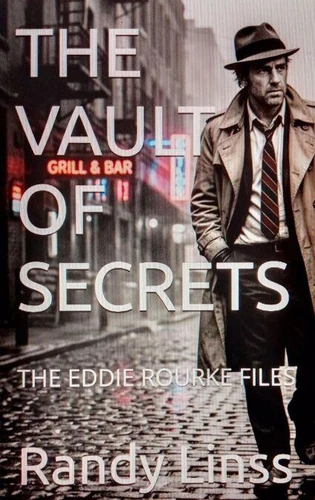
There was a day when the streets were kept safe by the likes of Dick Tracy, Marlowe, the Hardy Boys, and Hercule Peroit. For readers who grew up with them, it's sad to see what these sleuths' turf has become. If you're growing tired of books, movies, and music that bombards you with sex, blood & gore, and graphic violence, there's hope on the horizon. Meet Eddie Rourke. An Irish immigrant in his late 60s, who fled Dublin and its flawed police system to pursue a new life in America.
Now an old-school gumshoe private investigator, living in a gritty Uptown Chicago neighborhood, he is comfortable wearing a trenchcoat, fedora, a necktie loose at the neck, and a five o'clock shadow. Eddie is a perpetual outsider. He understands the streets, but he views American corruption through a unique, cynical lens. His office is in a fading downtown commercial building above a neon-lit jazz club.
Think brick alleyways, fire escapes, and the constant rumble of the elevated "L" train rattling his windows. The room, which doubles as an apartment, is heavy with the scent of Chesterfields, stale coffee, and wet asphalt from the window he keeps cracked. The frosted glass door reads E. Rourke - Private Investigations. A calendar from an Irish-American funeral home hangs on the wall. Sitting on his desk is a heavy black Western Electric rotary phone and a boxy Smith-Corona typewriter.
These are the stories of the cases of Eddie Rourke. As varied as the man, he turns up involved in some of the most unexpected cases, but with a fierce Irish tenacity, he won't stop until he has all the answers, putting the offending parties behind bars.