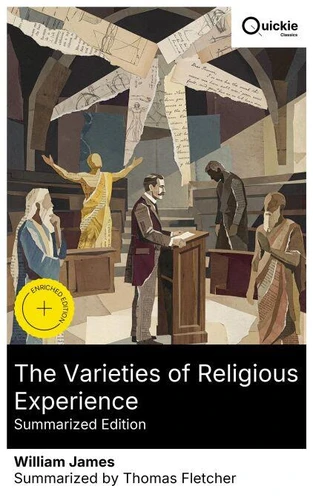
The Varieties of Religious Experience (Summarized Edition). Enriched edition. Philosophical Psychology, Natural Theology, and Spiritual Diversity in the Gifford Lectures
Par : ,Formats :
Disponible dans votre compte client Decitre ou Furet du Nord dès validation de votre commande. Le format ePub est :
- Compatible avec une lecture sur My Vivlio (smartphone, tablette, ordinateur)
- Compatible avec une lecture sur liseuses Vivlio
- Pour les liseuses autres que Vivlio, vous devez utiliser le logiciel Adobe Digital Edition. Non compatible avec la lecture sur les liseuses Kindle, Remarkable et Sony
 , qui est-ce ?
Notre partenaire de plateforme de lecture numérique où vous retrouverez l'ensemble de vos ebooks gratuitement
Pour en savoir plus sur nos ebooks, consultez notre aide en ligne ici
C'est si simple ! Lisez votre ebook avec l'app Vivlio sur votre tablette, mobile ou ordinateur :

- Nombre de pages153
- FormatePub
- ISBN859-65--4787901-5
- EAN8596547879015
- Date de parution10/01/2026
- Protection num.Digital Watermarking
- Taille856 Ko
- Infos supplémentairesepub
- ÉditeurBiblioBazaar
Résumé
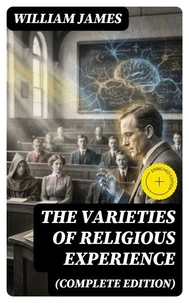
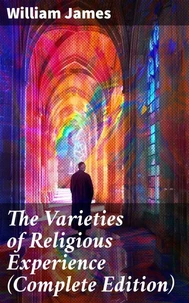
The Varieties of Religious Experience (Complete Edition) presents James's 1901-1902 Gifford Lectures as a psychologically exacting inquiry into conversion, mysticism, saintliness, and the "sick soul" versus "healthy-mindedness." Mining memoirs and clinical reports, he builds a phenomenology of religion that tests beliefs by their consequences-"by their fruits." The prose is lucid and case-rich, balancing clinical detachment with narrative verve.
Set at the crossroads of early scientific psychology, pragmatism, and post-Darwinian religious modernism, it ranges from St. Teresa to Tolstoy and Whitman. William James (1842-1910), Harvard psychologist-philosopher and a founding architect of pragmatism and radical empiricism, brought medical training and laboratory rigor to questions of meaning. His bouts of depression and neurasthenia, and experiments in altered states (including nitrous oxide), bred sympathy for extremity in faith.
Drawing on transatlantic networks and wide reading-Edwards, Teresa, Leuba, Starbuck-he sought to honor experience without doctrinal partisanship, reconciling scientific naturalism with plural religious value. This complete edition restores the full arc of his argument and cases, making it indispensable to scholars of religion, psychologists, philosophers, clinicians, and reflective seekers. Read it to assess spiritual claims without cynicism or credulity, to meet diverse textures of belief, and to see pragmatism at work as a humane method. Quickie Classics summarizes timeless works with precision, preserving the author's voice and keeping the prose clear, fast, and readable-distilled, never diluted.
Enriched Edition extras: Introduction · Synopsis · Historical Context · Author Biography · Brief Analysis · 4 Reflection Q&As · Editorial Footnotes.
Set at the crossroads of early scientific psychology, pragmatism, and post-Darwinian religious modernism, it ranges from St. Teresa to Tolstoy and Whitman. William James (1842-1910), Harvard psychologist-philosopher and a founding architect of pragmatism and radical empiricism, brought medical training and laboratory rigor to questions of meaning. His bouts of depression and neurasthenia, and experiments in altered states (including nitrous oxide), bred sympathy for extremity in faith.
Drawing on transatlantic networks and wide reading-Edwards, Teresa, Leuba, Starbuck-he sought to honor experience without doctrinal partisanship, reconciling scientific naturalism with plural religious value. This complete edition restores the full arc of his argument and cases, making it indispensable to scholars of religion, psychologists, philosophers, clinicians, and reflective seekers. Read it to assess spiritual claims without cynicism or credulity, to meet diverse textures of belief, and to see pragmatism at work as a humane method. Quickie Classics summarizes timeless works with precision, preserving the author's voice and keeping the prose clear, fast, and readable-distilled, never diluted.
Enriched Edition extras: Introduction · Synopsis · Historical Context · Author Biography · Brief Analysis · 4 Reflection Q&As · Editorial Footnotes.