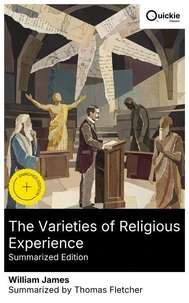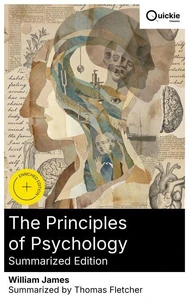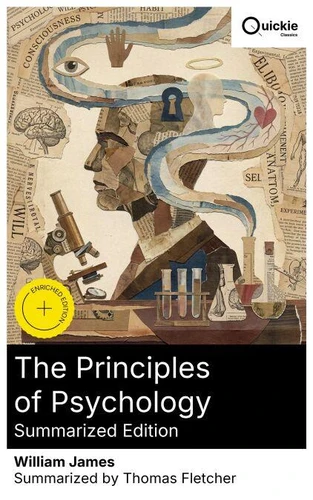
The Principles of Psychology (Summarized Edition). Enriched edition. Stream of consciousness, emotion and habit; attention, sensation, imagination, reasoning, and the exploration of mind
Par : ,Formats :
Disponible dans votre compte client Decitre ou Furet du Nord dès validation de votre commande. Le format ePub est :
- Compatible avec une lecture sur My Vivlio (smartphone, tablette, ordinateur)
- Compatible avec une lecture sur liseuses Vivlio
- Pour les liseuses autres que Vivlio, vous devez utiliser le logiciel Adobe Digital Edition. Non compatible avec la lecture sur les liseuses Kindle, Remarkable et Sony
 , qui est-ce ?
Notre partenaire de plateforme de lecture numérique où vous retrouverez l'ensemble de vos ebooks gratuitement
Pour en savoir plus sur nos ebooks, consultez notre aide en ligne ici
C'est si simple ! Lisez votre ebook avec l'app Vivlio sur votre tablette, mobile ou ordinateur :

- Nombre de pages408
- FormatePub
- ISBN859-65--4788023-3
- EAN8596547880233
- Date de parution10/01/2026
- Protection num.Digital Watermarking
- Taille1 Mo
- Infos supplémentairesepub
- ÉditeurQUICKIE CLASSICS
Résumé
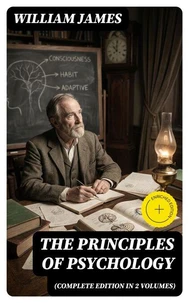
The Principles of Psychology (Complete Edition in 2 Volumes) is William James's 1890 synthesis of mind and behavior, marrying introspective acuity to physiological and experimental findings. In lucid, essayistic prose, James names the 'stream of consciousness, ' elaborates attention, habit, and ideomotor action, distinguishes the material, social, and spiritual selves, and defends the James-Lange account of emotion.
He contests associationist atomism and soul-substance metaphysics, preferring a functional, pluralistic psychology attuned to use and context. The two volumes range from sensation and memory to will and belief, interlacing case reports, thought experiments, and laboratory results. James-a Harvard professor trained in medicine-absorbed German experimentalism and British empiricism while resisting reductive mechanism; Darwin's biology and Renouvier's voluntarism shaped his account of habit and will.
His melancholy, pedagogy, and early demonstrations at Harvard pressed him toward a humane, anti-dogmatic stance that later blossomed into pragmatism and radical empiricism. Scholars of psychology, philosophy of mind, and literary modernism will find this complete edition indispensable: historically pivotal, methodologically adventurous, and still startlingly prescient on attention, habit, and the self.
Read it to encounter a foundational mind at full stretch, and to test contemporary theories against an unfailingly lucid, generous, and rigorous precursor. Quickie Classics summarizes timeless works with precision, preserving the author's voice and keeping the prose clear, fast, and readable-distilled, never diluted. Enriched Edition extras: Introduction · Synopsis · Historical Context · Author Biography · Brief Analysis · 4 Reflection Q&As · Editorial Footnotes.
He contests associationist atomism and soul-substance metaphysics, preferring a functional, pluralistic psychology attuned to use and context. The two volumes range from sensation and memory to will and belief, interlacing case reports, thought experiments, and laboratory results. James-a Harvard professor trained in medicine-absorbed German experimentalism and British empiricism while resisting reductive mechanism; Darwin's biology and Renouvier's voluntarism shaped his account of habit and will.
His melancholy, pedagogy, and early demonstrations at Harvard pressed him toward a humane, anti-dogmatic stance that later blossomed into pragmatism and radical empiricism. Scholars of psychology, philosophy of mind, and literary modernism will find this complete edition indispensable: historically pivotal, methodologically adventurous, and still startlingly prescient on attention, habit, and the self.
Read it to encounter a foundational mind at full stretch, and to test contemporary theories against an unfailingly lucid, generous, and rigorous precursor. Quickie Classics summarizes timeless works with precision, preserving the author's voice and keeping the prose clear, fast, and readable-distilled, never diluted. Enriched Edition extras: Introduction · Synopsis · Historical Context · Author Biography · Brief Analysis · 4 Reflection Q&As · Editorial Footnotes.