
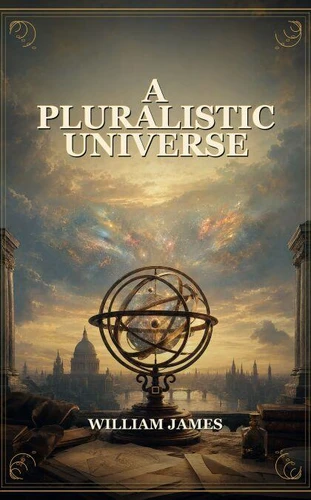
A Pluralistic Universe
Par :Formats :
Disponible dans votre compte client Decitre ou Furet du Nord dès validation de votre commande. Le format ePub est :
- Compatible avec une lecture sur My Vivlio (smartphone, tablette, ordinateur)
- Compatible avec une lecture sur liseuses Vivlio
- Pour les liseuses autres que Vivlio, vous devez utiliser le logiciel Adobe Digital Edition. Non compatible avec la lecture sur les liseuses Kindle, Remarkable et Sony
 , qui est-ce ?
Notre partenaire de plateforme de lecture numérique où vous retrouverez l'ensemble de vos ebooks gratuitement
Pour en savoir plus sur nos ebooks, consultez notre aide en ligne ici
C'est si simple ! Lisez votre ebook avec l'app Vivlio sur votre tablette, mobile ou ordinateur :

- Nombre de pages213
- FormatePub
- ISBN978-5-358-41438-9
- EAN9785358414389
- Date de parution19/05/2026
- Protection num.Digital Watermarking
- Taille2 Mo
- Infos supplémentairesepub
- ÉditeurDrofa
Résumé
Originally delivered as the 1908 Hibbert Lectures, A Pluralistic Universe provides an explanation of the philosophy known as "radical empiricism." This theory rejects the certainty of the "absolute, " an academic theory that holds that all existence is only the observable part of an all-encompassing entity that governs every detail in universe. By contrast, radical empiricism contends that while such an absolute may be possible, it's unprovable within the experiences of our finite lives, and so has little practical value.
Much like the theories James describes in his landmark work Pragmatism , radical empiricism evaluates the truth of a statement based on experiences and observations that we can actually have. This view doesn't exclude religion, as religion can be directly experienced, even if people may differ on exactly what the experience is. Anything that can be experienced must, by definition, exist, and therefore can be analyzed using radical empiricism.
When these lectures were given, the academic consensus was in favor of some version of the absolute. James spends much of the lectures discussing and critiquing the ideas of other philosophers, in particular Hegel, Fechner, and Bergson . He finds much to like in each of the works he discusses, but finds them all incomplete. William James (died 1910) was a prominent voice of the late 19th and early 20th century.
Their work has endured across generations and continues to be read and studied worldwide. The nonfiction literature of previous centuries offers invaluable windows into the minds and preoccupations of earlier ages. A Pluralistic Universe combines the personal and the universal in ways that continue to resonate with contemporary readers seeking to understand both history and human nature.
Much like the theories James describes in his landmark work Pragmatism , radical empiricism evaluates the truth of a statement based on experiences and observations that we can actually have. This view doesn't exclude religion, as religion can be directly experienced, even if people may differ on exactly what the experience is. Anything that can be experienced must, by definition, exist, and therefore can be analyzed using radical empiricism.
When these lectures were given, the academic consensus was in favor of some version of the absolute. James spends much of the lectures discussing and critiquing the ideas of other philosophers, in particular Hegel, Fechner, and Bergson . He finds much to like in each of the works he discusses, but finds them all incomplete. William James (died 1910) was a prominent voice of the late 19th and early 20th century.
Their work has endured across generations and continues to be read and studied worldwide. The nonfiction literature of previous centuries offers invaluable windows into the minds and preoccupations of earlier ages. A Pluralistic Universe combines the personal and the universal in ways that continue to resonate with contemporary readers seeking to understand both history and human nature.
A propos de William James
0,49 €





0,49 €










0,99 €