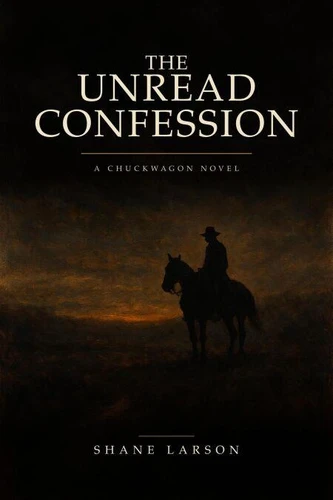
He carried the truth two hundred miles. He never read a word of it. Colorado, 1882. Barnaby Krell has ridden shotgun on the Oakhaven line for eleven years, guarding other men's paper across country he knows by the feel of it under a wheel. He cannot read a line of any of it. He has never needed to. A locked box is not an insult; it is a locked box. Then a man comes through a coach window in the rain with a knife, and dies, and what Krell takes out of his coat is a sealed confession in the hand of Corvus Vane - the rancher who owns every mile of range between here and Denver, and every marshal standing on it.
Vane has spent twenty years buying the silence of everyone who can read. He has never once had to buy a man who cannot. Two hundred miles lie between Krell and a United States marshal. Vane's riders are on the trail before the snow stops. And the only person who can tell Krell what he is carrying is a woman Vane tried to hire first - Ada Renfrew, who can read the page, and is hunted for it, and will not open it behind his back.
What Krell has instead of literacy is everything else: the ridge of a wheel rut, the colour of dirt under a man's fingernails, the exact way a friend lies. It is enough to keep him alive. It is not enough to keep the people around him alive. And he has a code he has never broken. I do not kill men for their sins. I deliver them to justice, even if I must drag them there myself. Before Denver, that code will cost him a friend at a rendezvous, a boy in the shale below a tree line, and the one advantage he has never had in his life: the chance to be certain of anything at all.
The Unread Confession is a hard, fast, dialogue-driven western about the frontier's real weapon - not the gun, but the page, and who is permitted to read it. Twenty chapters, a promised body count, and an ending that turns on a man who could not have been bought because there was nothing in his head worth the money. Book One of the Chuckwagon series. A protagonist whose limitation is the plot, not a quirk - every advantage he has is one you could learn from the ground An antagonist who never draws first and never has to, because he owns the marshal, the judge, and the man who feeds the judge's horse A code that is tested at the midpoint and does not break Snow on June slopes, a ghost camp, an underground river, and eighty riders working a trail in a line Twenty chapters, roughly 49, 000 words - a novel you can finish in an evening For readers who want the West as it actually ran: on deeds, ledgers, supply books, and the enormous number of people who signed their names with a mark and took somebody else's word for what they had agreed to.
He carried the truth two hundred miles. He never read a word of it. Colorado, 1882. Barnaby Krell has ridden shotgun on the Oakhaven line for eleven years, guarding other men's paper across country he knows by the feel of it under a wheel. He cannot read a line of any of it. He has never needed to. A locked box is not an insult; it is a locked box. Then a man comes through a coach window in the rain with a knife, and dies, and what Krell takes out of his coat is a sealed confession in the hand of Corvus Vane - the rancher who owns every mile of range between here and Denver, and every marshal standing on it.
Vane has spent twenty years buying the silence of everyone who can read. He has never once had to buy a man who cannot. Two hundred miles lie between Krell and a United States marshal. Vane's riders are on the trail before the snow stops. And the only person who can tell Krell what he is carrying is a woman Vane tried to hire first - Ada Renfrew, who can read the page, and is hunted for it, and will not open it behind his back.
What Krell has instead of literacy is everything else: the ridge of a wheel rut, the colour of dirt under a man's fingernails, the exact way a friend lies. It is enough to keep him alive. It is not enough to keep the people around him alive. And he has a code he has never broken. I do not kill men for their sins. I deliver them to justice, even if I must drag them there myself. Before Denver, that code will cost him a friend at a rendezvous, a boy in the shale below a tree line, and the one advantage he has never had in his life: the chance to be certain of anything at all.
The Unread Confession is a hard, fast, dialogue-driven western about the frontier's real weapon - not the gun, but the page, and who is permitted to read it. Twenty chapters, a promised body count, and an ending that turns on a man who could not have been bought because there was nothing in his head worth the money. Book One of the Chuckwagon series. A protagonist whose limitation is the plot, not a quirk - every advantage he has is one you could learn from the ground An antagonist who never draws first and never has to, because he owns the marshal, the judge, and the man who feeds the judge's horse A code that is tested at the midpoint and does not break Snow on June slopes, a ghost camp, an underground river, and eighty riders working a trail in a line Twenty chapters, roughly 49, 000 words - a novel you can finish in an evening For readers who want the West as it actually ran: on deeds, ledgers, supply books, and the enormous number of people who signed their names with a mark and took somebody else's word for what they had agreed to.

 , qui est-ce ?