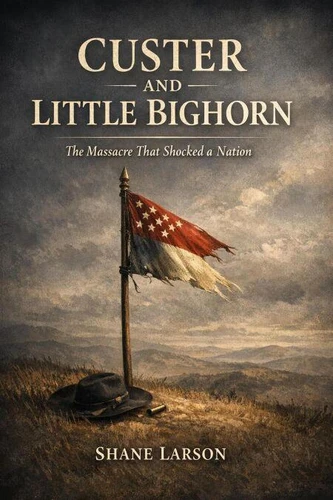
Almost everything you know about Custer's Last Stand is a painting, not a battle - and much of it was invented on purpose. On June 25, 1876, nine days before the nation's centennial, George Armstrong Custer led five companies of the Seventh Cavalry into a valley in Montana Territory, and within an hour or two every man with him was dead. The news reached the East during the Fourth of July celebrations, and America has been arguing about what happened there ever since.
For a century, the argument was shaped by the one thing the Army lacked: a single surviving witness from Custer's command. Into that silence poured the myth - the golden-haired hero ringed by fallen troopers, dying gallantly against overwhelming odds. Much of that image was manufactured deliberately, above all by Elizabeth Custer, whose fifty-year widowhood became history's most successful public-relations campaign.
But we now know, in remarkable detail, what actually happened - from the two witnesses the myth ignored: the Native participants and the ground itself. Lakota and Cheyenne accounts, dismissed for a century, describe a swift, fragmenting collapse rather than a heroic stand. Then a 1983 grass fire stripped the battlefield bare, and the forensic archaeology that followed - thousands of cartridge cases mapped and matched firearm by firearm - confirmed the Native testimony in astonishing detail.
The evidence and the eyewitnesses converge on the same battle. It is not the one on the barroom lithograph. This is the evidence-first account: Custer the fading Civil War celebrity, the broken treaty over the Black Hills that manufactured the war, the campaign's fatal assumptions, the battle rebuilt from its best evidence, and the long aftermath - the myth machine, the vindication of the Native record, and the road to Wounded Knee.
Inside this book: Why the Last Stand is largely a myth - and exactly who built it, and why The Black Hills treaty violation that made the campaign an enforcement of theft Sitting Bull and Crazy Horse, and the largest village on the plains The battle reconstructed from Native testimony and 1980s forensic archaeology The command failures: the intelligence disaster, the divided regiment, Reno and Benteen The bitter coda: fourteen years later, the same regiment at Wounded Knee This book is for you if: You want what really happened at the Little Bighorn, not the legend You love evidence-first military history and battlefield forensics You've read Philbrick, Cozzens, or Gwynne and want a focused, affordable account You've visited the battlefield, or mean to Strip away a century of myth and meet the real battle.
Read Custer and Little Bighorn today.
Almost everything you know about Custer's Last Stand is a painting, not a battle - and much of it was invented on purpose. On June 25, 1876, nine days before the nation's centennial, George Armstrong Custer led five companies of the Seventh Cavalry into a valley in Montana Territory, and within an hour or two every man with him was dead. The news reached the East during the Fourth of July celebrations, and America has been arguing about what happened there ever since.
For a century, the argument was shaped by the one thing the Army lacked: a single surviving witness from Custer's command. Into that silence poured the myth - the golden-haired hero ringed by fallen troopers, dying gallantly against overwhelming odds. Much of that image was manufactured deliberately, above all by Elizabeth Custer, whose fifty-year widowhood became history's most successful public-relations campaign.
But we now know, in remarkable detail, what actually happened - from the two witnesses the myth ignored: the Native participants and the ground itself. Lakota and Cheyenne accounts, dismissed for a century, describe a swift, fragmenting collapse rather than a heroic stand. Then a 1983 grass fire stripped the battlefield bare, and the forensic archaeology that followed - thousands of cartridge cases mapped and matched firearm by firearm - confirmed the Native testimony in astonishing detail.
The evidence and the eyewitnesses converge on the same battle. It is not the one on the barroom lithograph. This is the evidence-first account: Custer the fading Civil War celebrity, the broken treaty over the Black Hills that manufactured the war, the campaign's fatal assumptions, the battle rebuilt from its best evidence, and the long aftermath - the myth machine, the vindication of the Native record, and the road to Wounded Knee.
Inside this book: Why the Last Stand is largely a myth - and exactly who built it, and why The Black Hills treaty violation that made the campaign an enforcement of theft Sitting Bull and Crazy Horse, and the largest village on the plains The battle reconstructed from Native testimony and 1980s forensic archaeology The command failures: the intelligence disaster, the divided regiment, Reno and Benteen The bitter coda: fourteen years later, the same regiment at Wounded Knee This book is for you if: You want what really happened at the Little Bighorn, not the legend You love evidence-first military history and battlefield forensics You've read Philbrick, Cozzens, or Gwynne and want a focused, affordable account You've visited the battlefield, or mean to Strip away a century of myth and meet the real battle.
Read Custer and Little Bighorn today.

 , qui est-ce ?