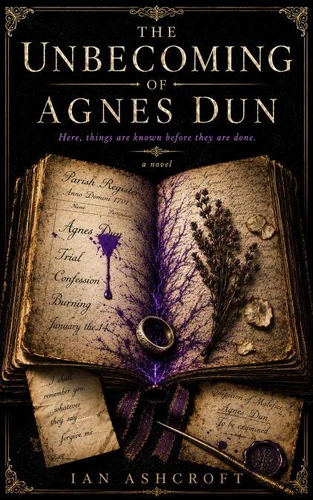
1670s Scotland. In a remote parish schooled in the finding of witches, Agnes Dun has committed the one unforgivable sin: she was never chosen. Unmarried, unclaimed, a house no one enters - until a warmth comes to her in the dark that asks nothing, and stays. What follows is not a haunting but a gestation. The parish begins to slip out of time: the dead are grieved before they die, birds fall from a windless sky already pointing one way, rain refuses her roof, and the beasts in the byres are born wrong - almost right, as though drawn by something that heard a cow described but never saw one.
One by one Agnes's own senses are stolen and replaced: she sees the dying stacked behind the living, hears a vast slow beat beneath the world's silence, smells the grave rising through her own skin. And in the kirk's ledger, in ink already dry, her confession waits - sworn freely, and without compulsion - for the day she will arrive to speak it. Told in Agnes's own unbearably intimate voice, The Unbecoming of Agnes Dun asks what is left of a soul when the doing is written but the being is not - and closes on a revelation that turns the reader's own sympathy into the mechanism of the horror.
Some books frighten you. This one leaves the warmth at the foot of your bed after you close it.
1670s Scotland. In a remote parish schooled in the finding of witches, Agnes Dun has committed the one unforgivable sin: she was never chosen. Unmarried, unclaimed, a house no one enters - until a warmth comes to her in the dark that asks nothing, and stays. What follows is not a haunting but a gestation. The parish begins to slip out of time: the dead are grieved before they die, birds fall from a windless sky already pointing one way, rain refuses her roof, and the beasts in the byres are born wrong - almost right, as though drawn by something that heard a cow described but never saw one.
One by one Agnes's own senses are stolen and replaced: she sees the dying stacked behind the living, hears a vast slow beat beneath the world's silence, smells the grave rising through her own skin. And in the kirk's ledger, in ink already dry, her confession waits - sworn freely, and without compulsion - for the day she will arrive to speak it. Told in Agnes's own unbearably intimate voice, The Unbecoming of Agnes Dun asks what is left of a soul when the doing is written but the being is not - and closes on a revelation that turns the reader's own sympathy into the mechanism of the horror.
Some books frighten you. This one leaves the warmth at the foot of your bed after you close it.

 , qui est-ce ?