SOLDES
Jusqu'à -70% sur une sélection d'articles*

Nouveauté
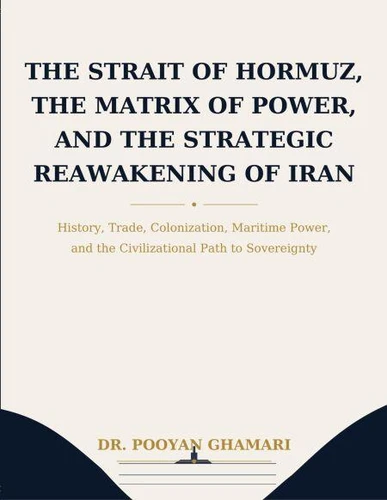
The Strait of Hormuz, the Matrix of Power, and the Strategic Reawakening of Iran. History, Trade, Colonization, Maritime Power, and the Civilizational Path to Sovereignty
Par :Formats :
Disponible dans votre compte client Decitre ou Furet du Nord dès validation de votre commande. Le format ePub est :
- Compatible avec une lecture sur My Vivlio (smartphone, tablette, ordinateur)
- Compatible avec une lecture sur liseuses Vivlio
- Pour les liseuses autres que Vivlio, vous devez utiliser le logiciel Adobe Digital Edition. Non compatible avec la lecture sur les liseuses Kindle, Remarkable et Sony
 , qui est-ce ?
Notre partenaire de plateforme de lecture numérique où vous retrouverez l'ensemble de vos ebooks gratuitement
Pour en savoir plus sur nos ebooks, consultez notre aide en ligne ici
C'est si simple ! Lisez votre ebook avec l'app Vivlio sur votre tablette, mobile ou ordinateur :

- Nombre de pages64
- FormatePub
- ISBN978-3-6963-1845-1
- EAN9783696318451
- Date de parution28/05/2026
- Protection num.Digital Watermarking
- Taille235 Ko
- Infos supplémentairesepub
- ÉditeurBoD - Books on Demand
Résumé
The Strait of Hormuz, the Matrix of Power, and the Strategic Reawakening of Iran is a work of strategic analysis, historical interpretation, and political thought by Dr. Pooyan Ghamari.
The book examines the Strait of Hormuz not merely as a maritime corridor, but as a revealing pressure point in the architecture of modern power. It explores how geography, trade routes, colonization, sanctions, insurance systems, legal asymmetry, corridor competition, and narrative control shape sovereignty in the twenty-first century.
Moving from historical trade systems and maritime empire to modern dependency structures and lawful national reconstruction, the book asks how a serious nation can transform strategic pressure into long-term capability.
It argues that real sovereignty is not rebuilt by rhetoric alone, but through ports that function, legal systems that reduce arbitrariness, industries that move beyond raw export, institutions that deserve trust, and a political culture disciplined enough to build under pressure. Written for readers in government, diplomacy, law, economics, strategy, and serious public life, this book offers a rigorous framework for understanding the Strait of Hormuz, the deeper matrix of power around it, and the civilizational path from chokepoint to sovereign capability.
It argues that real sovereignty is not rebuilt by rhetoric alone, but through ports that function, legal systems that reduce arbitrariness, industries that move beyond raw export, institutions that deserve trust, and a political culture disciplined enough to build under pressure. Written for readers in government, diplomacy, law, economics, strategy, and serious public life, this book offers a rigorous framework for understanding the Strait of Hormuz, the deeper matrix of power around it, and the civilizational path from chokepoint to sovereign capability.
A propos de Pooyan Ghamari

9,99 €