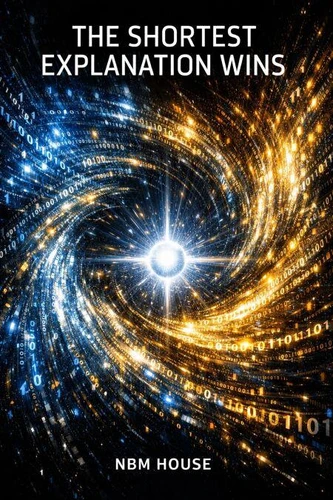
The Shortest Explanation Wins: Solomonoff Induction and the Logic Beneath Intelligence
Par :Formats :
Disponible dans votre compte client Decitre ou Furet du Nord dès validation de votre commande. Le format ePub est :
- Compatible avec une lecture sur My Vivlio (smartphone, tablette, ordinateur)
- Compatible avec une lecture sur liseuses Vivlio
- Pour les liseuses autres que Vivlio, vous devez utiliser le logiciel Adobe Digital Edition. Non compatible avec la lecture sur les liseuses Kindle, Remarkable et Sony
 , qui est-ce ?
Notre partenaire de plateforme de lecture numérique où vous retrouverez l'ensemble de vos ebooks gratuitement
Pour en savoir plus sur nos ebooks, consultez notre aide en ligne ici
C'est si simple ! Lisez votre ebook avec l'app Vivlio sur votre tablette, mobile ou ordinateur :

- FormatePub
- ISBN8233755316
- EAN9798233755316
- Date de parution19/02/2026
- Protection num.pas de protection
- Infos supplémentairesepub
- ÉditeurLinda Balsamo
Résumé
For more than two thousand years, philosophers have wrestled with the problem of induction: we cannot logically prove that the future will resemble the past, yet every prediction we make - from sunrise tomorrow to the next bridge holding our weight - depends on exactly that assumption. Hume showed the justification is circular. Popper, pragmatists, and statisticians offered patches. None sealed the leak.
Then, in the 1960s, Ray Solomonoff discovered something astonishing: there is a mathematically optimal way to generalize from evidence, one that no other method can systematically beat across all computable worlds. It requires no special assumptions about nature, only that the processes generating our observations are computable (as far as physics has ever shown). The trick? Treat every possible explanation as a computer program, and weight them by how short they are.
Shorter programs - simpler explanations - receive exponentially higher prior probability. Prediction becomes Bayesian updating over this universal prior. The result is Solomonoff induction: the formal vindication of Occam's Razor as a theorem, not a heuristic. This is not just abstract philosophy. It collapses prediction, compression, and understanding into one operation. Intelligence - whether in a bacterium, a child, a scientist, or a large language model - turns out to be the search for short descriptions of complex phenomena.
The shortest explanation really does win, and the mathematics tells us exactly why. Written with clarity and intellectual drama, The Shortest Explanation Wins traces the history of the induction problem from Hume and Goodman through information theory and computation to Solomonoff's quiet revolution. It explains - without equations - why statistics isn't enough, why priors cannot be arbitrary, why deep learning works when it does, and what the uncomputable ideal reveals about the limits of knowledge itself.
If you have ever wondered why simplicity predicts better than complexity, why science converges, or what intelligence fundamentally is, this book offers the deepest, most principled answer yet discovered. For readers of Hume, Jaynes, Hofstadter, Wolfram, Tegmark, and anyone who wants to understand the logic beneath rational thought - and beneath intelligence itself.
Then, in the 1960s, Ray Solomonoff discovered something astonishing: there is a mathematically optimal way to generalize from evidence, one that no other method can systematically beat across all computable worlds. It requires no special assumptions about nature, only that the processes generating our observations are computable (as far as physics has ever shown). The trick? Treat every possible explanation as a computer program, and weight them by how short they are.
Shorter programs - simpler explanations - receive exponentially higher prior probability. Prediction becomes Bayesian updating over this universal prior. The result is Solomonoff induction: the formal vindication of Occam's Razor as a theorem, not a heuristic. This is not just abstract philosophy. It collapses prediction, compression, and understanding into one operation. Intelligence - whether in a bacterium, a child, a scientist, or a large language model - turns out to be the search for short descriptions of complex phenomena.
The shortest explanation really does win, and the mathematics tells us exactly why. Written with clarity and intellectual drama, The Shortest Explanation Wins traces the history of the induction problem from Hume and Goodman through information theory and computation to Solomonoff's quiet revolution. It explains - without equations - why statistics isn't enough, why priors cannot be arbitrary, why deep learning works when it does, and what the uncomputable ideal reveals about the limits of knowledge itself.
If you have ever wondered why simplicity predicts better than complexity, why science converges, or what intelligence fundamentally is, this book offers the deepest, most principled answer yet discovered. For readers of Hume, Jaynes, Hofstadter, Wolfram, Tegmark, and anyone who wants to understand the logic beneath rational thought - and beneath intelligence itself.
A propos de NBM House

3,49 €