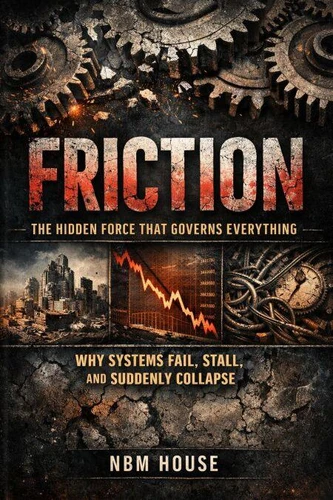
Friction: The Hidden Force That Governs Everything
Par :Formats :
Disponible dans votre compte client Decitre ou Furet du Nord dès validation de votre commande. Le format ePub est :
- Compatible avec une lecture sur My Vivlio (smartphone, tablette, ordinateur)
- Compatible avec une lecture sur liseuses Vivlio
- Pour les liseuses autres que Vivlio, vous devez utiliser le logiciel Adobe Digital Edition. Non compatible avec la lecture sur les liseuses Kindle, Remarkable et Sony
 , qui est-ce ?
Notre partenaire de plateforme de lecture numérique où vous retrouverez l'ensemble de vos ebooks gratuitement
Pour en savoir plus sur nos ebooks, consultez notre aide en ligne ici
C'est si simple ! Lisez votre ebook avec l'app Vivlio sur votre tablette, mobile ou ordinateur :

- FormatePub
- ISBN8233457470
- EAN9798233457470
- Date de parution05/03/2026
- Protection num.pas de protection
- Infos supplémentairesepub
- ÉditeurLinda Balsamo
Résumé
In every system that moves water, information, money, authority, attention - or anything else of value - friction is not a bug. It is the central design reality. This groundbreaking book reframes failure, stagnation, and sudden collapse across organizations, governments, markets, militaries, supply chains, hospitals, AI pipelines, and even biological aging as the predictable result of one hidden force: friction.
Drawing on Roman aqueduct engineering, Shannon's information theory, Clausius and entropy, Parkinson's Law, Goodhart's Law, systems dynamics, cognitive science, and real-world case studies (the F-35 program, the 2008 financial crisis, the French collapse of 1940, hospital dysfunction, regulatory overreach, AI governance mismatches, and biological senescence), the author reveals:. Why friction is not random - it accumulates through five distinct species (physical, informational, institutional, psychological, moral) and follows compound, entropic dynamics.. How organizations quietly drift toward higher drag through rule proliferation, incentive drift, feedback degradation, cognitive bottlenecks, identity-protective cognition, and trust erosion - often while output metrics still look acceptable.. Why most reform efforts redistribute friction rather than reduce it, and why crises are usually required before serious maintenance occurs.. Where friction hides today: bloated procurement, compliance theater, decision latency, emotional distortion, institutional masks, senescent cells, mismatched AI speeds.. A practical five-step friction audit methodology - node mapping, delay measurement, energy-leakage identification, targeted intervention, drift monitoring - that any organization can apply to reclaim coordination efficiency.. The surprising truth that some friction is load-bearing - it damps oscillation, enforces commitment, provides control margins, and stabilizes systems.
The goal is never zero friction; it is optimized friction calibrated to reality. From the illusion of "seamless" tech experiences (which merely displace friction) to the future of AI governance, biological longevity, and societal adaptation, this book offers a unifying language and diagnostic framework for understanding why complex systems so reliably disappoint - and what intelligent maintenance looks like before the next inevitable breakdown.
If you've ever wondered why capable people inside broken systems produce mediocre outcomes. why reform so rarely works. why bureaucracies expand while empires contract. why organizations forget what they once knew. or why progress feels harder the larger and older the system becomes - this is the book that finally explains the mechanism. Not another management fad. A fundamental re-understanding of organized human activity.
Perfect for: CEOs, policymakers, engineers, consultants, military officers, regulators, AI builders, gerontologists, complexity thinkers, and anyone tired of treating symptoms instead of the underlying physics of coordination.
Drawing on Roman aqueduct engineering, Shannon's information theory, Clausius and entropy, Parkinson's Law, Goodhart's Law, systems dynamics, cognitive science, and real-world case studies (the F-35 program, the 2008 financial crisis, the French collapse of 1940, hospital dysfunction, regulatory overreach, AI governance mismatches, and biological senescence), the author reveals:. Why friction is not random - it accumulates through five distinct species (physical, informational, institutional, psychological, moral) and follows compound, entropic dynamics.. How organizations quietly drift toward higher drag through rule proliferation, incentive drift, feedback degradation, cognitive bottlenecks, identity-protective cognition, and trust erosion - often while output metrics still look acceptable.. Why most reform efforts redistribute friction rather than reduce it, and why crises are usually required before serious maintenance occurs.. Where friction hides today: bloated procurement, compliance theater, decision latency, emotional distortion, institutional masks, senescent cells, mismatched AI speeds.. A practical five-step friction audit methodology - node mapping, delay measurement, energy-leakage identification, targeted intervention, drift monitoring - that any organization can apply to reclaim coordination efficiency.. The surprising truth that some friction is load-bearing - it damps oscillation, enforces commitment, provides control margins, and stabilizes systems.
The goal is never zero friction; it is optimized friction calibrated to reality. From the illusion of "seamless" tech experiences (which merely displace friction) to the future of AI governance, biological longevity, and societal adaptation, this book offers a unifying language and diagnostic framework for understanding why complex systems so reliably disappoint - and what intelligent maintenance looks like before the next inevitable breakdown.
If you've ever wondered why capable people inside broken systems produce mediocre outcomes. why reform so rarely works. why bureaucracies expand while empires contract. why organizations forget what they once knew. or why progress feels harder the larger and older the system becomes - this is the book that finally explains the mechanism. Not another management fad. A fundamental re-understanding of organized human activity.
Perfect for: CEOs, policymakers, engineers, consultants, military officers, regulators, AI builders, gerontologists, complexity thinkers, and anyone tired of treating symptoms instead of the underlying physics of coordination.
A propos de NBM House


3,49 €