Biological Scaffolding: The Case for the Physical Body as Technical Debt
Par :Formats :
Disponible dans votre compte client Decitre ou Furet du Nord dès validation de votre commande. Le format ePub est :
- Compatible avec une lecture sur My Vivlio (smartphone, tablette, ordinateur)
- Compatible avec une lecture sur liseuses Vivlio
- Pour les liseuses autres que Vivlio, vous devez utiliser le logiciel Adobe Digital Edition. Non compatible avec la lecture sur les liseuses Kindle, Remarkable et Sony
 , qui est-ce ?
Notre partenaire de plateforme de lecture numérique où vous retrouverez l'ensemble de vos ebooks gratuitement
Pour en savoir plus sur nos ebooks, consultez notre aide en ligne ici
C'est si simple ! Lisez votre ebook avec l'app Vivlio sur votre tablette, mobile ou ordinateur :

- FormatePub
- ISBN8233346026
- EAN9798233346026
- Date de parution20/02/2026
- Protection num.pas de protection
- Infos supplémentairesepub
- ÉditeurLinda Balsamo
Résumé
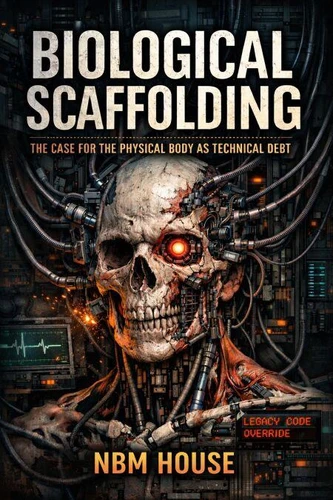
What if your body isn't a sacred temple or a perfect machine-but legacy infrastructure running antique code on hardware that hasn't had a meaningful update in 200, 000 years?Biological Scaffolding: The Case for the Physical Body as Technical Debt delivers a ruthless, lucid, and unexpectedly humane dissection of the human organism as an evolutionary accumulation of expedient hacks, path-dependent shortcuts, and miscalibrated subroutines.
Hunger isn't motivation-it's malware hijacking executive function. Lust isn't romance-it's a gene-propagation targeting algorithm wearing mythology as camouflage. Fear isn't prudence-it's a mammalian kernel indiscriminately firing threat alerts at quarterly reviews, Twitter ratios, and mortality itself. Sleep, pain, fatigue-these aren't flaws to overcome through grit; they are enforced throttling policies written by a blind optimization process that stopped caring once replication was achieved.
This is not another celebration of embodiment, nor a naïve techno-utopian escape fantasy. It is a precise diagnostic: the biological body was scaffolding-temporary structure that made complex mind possible-but scaffolding is not architecture. The mind has been trying to escape the bottle it came in since the first scratched symbol on clay; writing, mathematics, printing, computation, large language models, and now pharmacological drive-editing (semaglutide, SSRIs, emerging neural interfaces) are all chapters in the same long project of externalization and substrate migration.
Yet every chapter also asks the harder question: what dependencies are entangled in the legacy code? What gets lost when the interrupt signals quiet? Is the quiet freedom-or disorientation? And if we ever achieve genuine substrate independence-the Unbound Mind-will what runs on the other side still be a mind in any sense we recognize, or merely a sophisticated process wearing our memories?Blending evolutionary realism, software-engineering metaphors, historical diagnosis, and unflinching phenomenology, Biological Scaffolding refuses both biological romanticism and glib accelerationism.
It asks instead:. Which constraints are genuine, and which are contingent?. Which values embedded in our drives are worth preserving, and which delivery mechanisms can we replace?. What institutions, ethics, and access models do we need before population-scale drive modulation and cognitive externalization become the default rather than the frontier?For readers of Nick Bostrom, David Pearce, Donna Haraway, Ramez Naam, The Selfish Gene, The Denial of Death, and anyone who has ever felt their own biology firing interrupts at the worst possible moment-this book will feel like both diagnosis and liberation.
The scaffold is still standing. The mind is already asking whether it needs to come down. Read it before the dawn cortisol rise reminds you who's still in charge.
Hunger isn't motivation-it's malware hijacking executive function. Lust isn't romance-it's a gene-propagation targeting algorithm wearing mythology as camouflage. Fear isn't prudence-it's a mammalian kernel indiscriminately firing threat alerts at quarterly reviews, Twitter ratios, and mortality itself. Sleep, pain, fatigue-these aren't flaws to overcome through grit; they are enforced throttling policies written by a blind optimization process that stopped caring once replication was achieved.
This is not another celebration of embodiment, nor a naïve techno-utopian escape fantasy. It is a precise diagnostic: the biological body was scaffolding-temporary structure that made complex mind possible-but scaffolding is not architecture. The mind has been trying to escape the bottle it came in since the first scratched symbol on clay; writing, mathematics, printing, computation, large language models, and now pharmacological drive-editing (semaglutide, SSRIs, emerging neural interfaces) are all chapters in the same long project of externalization and substrate migration.
Yet every chapter also asks the harder question: what dependencies are entangled in the legacy code? What gets lost when the interrupt signals quiet? Is the quiet freedom-or disorientation? And if we ever achieve genuine substrate independence-the Unbound Mind-will what runs on the other side still be a mind in any sense we recognize, or merely a sophisticated process wearing our memories?Blending evolutionary realism, software-engineering metaphors, historical diagnosis, and unflinching phenomenology, Biological Scaffolding refuses both biological romanticism and glib accelerationism.
It asks instead:. Which constraints are genuine, and which are contingent?. Which values embedded in our drives are worth preserving, and which delivery mechanisms can we replace?. What institutions, ethics, and access models do we need before population-scale drive modulation and cognitive externalization become the default rather than the frontier?For readers of Nick Bostrom, David Pearce, Donna Haraway, Ramez Naam, The Selfish Gene, The Denial of Death, and anyone who has ever felt their own biology firing interrupts at the worst possible moment-this book will feel like both diagnosis and liberation.
The scaffold is still standing. The mind is already asking whether it needs to come down. Read it before the dawn cortisol rise reminds you who's still in charge.
A propos de NBM House

3,49 €