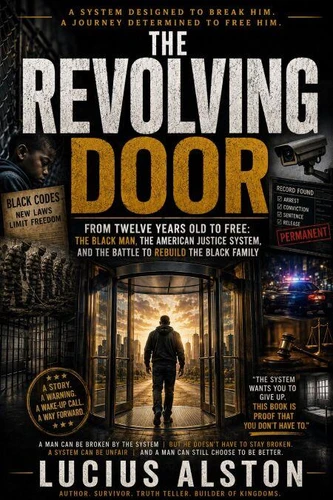
He entered the justice system at twelve years old. He kept getting out. He kept going back. More than four decades later, Lucius Alston finally understood that release and freedom were not the same thing. THE REVOLVING DOOR is part memoir, part history, part social investigation, and part intervention manual. Alston traces the long road surrounding the Black boy and Black man from slavery era family disruption and post emancipation criminalization to segregation, the war on drugs, the 100 to 1 crack/powder sentencing disparity, mass incarceration, reentry barriers, school discipline, employment screening, survelliance technology, and the modern systems that can follow a conviction long after a sentence ends.
But this is not a book of excuses, Alston turns the same light on black men, black women, fathers, families, churches, street culture, and himself. His central truth is deliberately uncomfortable: a system can be unfair and a man can still be guilty. Structural injustice and personal responsibility can exist in the same sentence. Across sixty chapters, the revolving door asks what happened to the black family, whey black men and women increasingly experience one another as opponents, what incarceration does to children and relationships, and why getting out is easier than learning how to stay out.
The closing sections become a practical blueprint for prevention, the first ninety days after release, family reunification, mentoring, church based reentry, employment, housing, accountability, and restoration.
He entered the justice system at twelve years old. He kept getting out. He kept going back. More than four decades later, Lucius Alston finally understood that release and freedom were not the same thing. THE REVOLVING DOOR is part memoir, part history, part social investigation, and part intervention manual. Alston traces the long road surrounding the Black boy and Black man from slavery era family disruption and post emancipation criminalization to segregation, the war on drugs, the 100 to 1 crack/powder sentencing disparity, mass incarceration, reentry barriers, school discipline, employment screening, survelliance technology, and the modern systems that can follow a conviction long after a sentence ends.
But this is not a book of excuses, Alston turns the same light on black men, black women, fathers, families, churches, street culture, and himself. His central truth is deliberately uncomfortable: a system can be unfair and a man can still be guilty. Structural injustice and personal responsibility can exist in the same sentence. Across sixty chapters, the revolving door asks what happened to the black family, whey black men and women increasingly experience one another as opponents, what incarceration does to children and relationships, and why getting out is easier than learning how to stay out.
The closing sections become a practical blueprint for prevention, the first ninety days after release, family reunification, mentoring, church based reentry, employment, housing, accountability, and restoration.


 , qui est-ce ?