Talia Westcott is a nonfiction author who writes about modern culture, identity, and personal development. Her work combines reflective storytelling with practical insight, exploring how people adapt, grow, and find meaning in a fast-changing world.
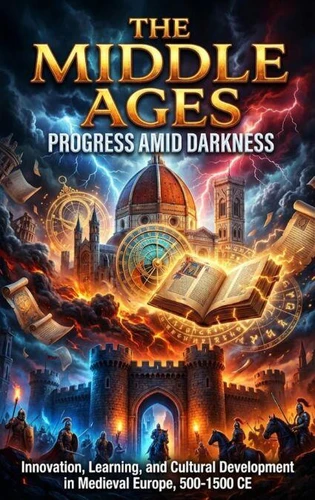
The Middle Ages: Progress Amid Darkness. Innovation, Learning, and Cultural Development in Medieval Europe, 500-1500 CE
Par :Formats :
Disponible dans votre compte client Decitre ou Furet du Nord dès validation de votre commande. Le format ePub est :
- Compatible avec une lecture sur My Vivlio (smartphone, tablette, ordinateur)
- Compatible avec une lecture sur liseuses Vivlio
- Pour les liseuses autres que Vivlio, vous devez utiliser le logiciel Adobe Digital Edition. Non compatible avec la lecture sur les liseuses Kindle, Remarkable et Sony
 , qui est-ce ?
Notre partenaire de plateforme de lecture numérique où vous retrouverez l'ensemble de vos ebooks gratuitement
Pour en savoir plus sur nos ebooks, consultez notre aide en ligne ici
C'est si simple ! Lisez votre ebook avec l'app Vivlio sur votre tablette, mobile ou ordinateur :

- Nombre de pages204
- FormatePub
- ISBN978-3-565-25088-2
- EAN9783565250882
- Date de parution16/02/2026
- Protection num.pas de protection
- Taille2 Mo
- Infos supplémentairesepub
- ÉditeurEmphaloz Publishing House
Résumé
The medieval millennium witnessed remarkable intellectual, technological, and cultural achievements that fundamentally reshaped European civilization-achievements long obscured by the misleading label "Dark Ages." This history challenges persistent myths by examining how medieval society generated innovations in agriculture, architecture, philosophy, and governance that laid foundations for the modern world.
Drawing on manuscript evidence, archaeological discoveries, architectural analysis, and contemporary chronicles, the narrative traces genuine progress across centuries often dismissed as stagnant.
Monasteries preserved classical learning while developing new pedagogical methods. Universities emerged in Bologna, Paris, and Oxford, establishing institutional frameworks for higher education. Scholastic philosophers reconciled Aristotelian logic with Christian theology, creating sophisticated intellectual systems. Gothic cathedrals demonstrated advanced engineering and mathematical knowledge. The book documents practical innovations that transformed daily life: the heavy plow and three-field rotation increased agricultural productivity; watermills and windmills mechanized production; advances in metallurgy improved tools and weapons; maritime technology enabled long-distance trade networks.
Legal developments included common law traditions, representative assemblies, and institutions that limited monarchical power. The twelfth-century renaissance saw translations of Arabic and Greek texts flood Europe, transmitting preserved classical knowledge alongside Islamic scientific and mathematical achievements.
Monasteries preserved classical learning while developing new pedagogical methods. Universities emerged in Bologna, Paris, and Oxford, establishing institutional frameworks for higher education. Scholastic philosophers reconciled Aristotelian logic with Christian theology, creating sophisticated intellectual systems. Gothic cathedrals demonstrated advanced engineering and mathematical knowledge. The book documents practical innovations that transformed daily life: the heavy plow and three-field rotation increased agricultural productivity; watermills and windmills mechanized production; advances in metallurgy improved tools and weapons; maritime technology enabled long-distance trade networks.
Legal developments included common law traditions, representative assemblies, and institutions that limited monarchical power. The twelfth-century renaissance saw translations of Arabic and Greek texts flood Europe, transmitting preserved classical knowledge alongside Islamic scientific and mathematical achievements.