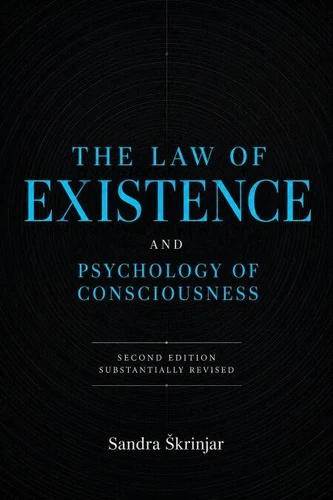
What must exist before thought, interpretation, and action become visible?The Law of Existence and Psychology of Consciousness begins before the observable result. At the center of the book is the relationT = C? × U³through which Sandra Skrinjar develops a theoretical architecture of initiation, stabilization, realization, embodiment, transformation, and accuracy. The book asks what must already be active before developed human forms appear, and what happens as a foundational relation passes into registration, sensation, perception, intuition, orientation, interpretation, meaning, thought, emotion, language, choice, action, consequence, and further information.
Its central concern is not whether form changes. Change is necessary. The question is whether the relevant relation remains preserved through transformation. This substantially revised second edition clarifies the formal notation of the Law of Existence and carefully separates mathematical identity, theoretical assignment, and empirical finding. It distinguishes T = C? × U³ as the formal-relational expression of the model, T = 0 as the zero-distortion state notation, 0?1 as the model-defined passage into realization, and ?T as the marker of downstream deviation when the relevant relation is no longer preserved.
The book also examines the theoretical roles of C? and U³, the position of the 10?²¹-second scale, energy, vibration, frequency, embodiment, the heart as the proposed earliest bodily register, coherence, stability, distortion, and the boundary between established scientific findings and theoretical propositions. Rather than treating consciousness only at the level of thought or interpretation, the book follows the sequence through which what is first registered becomes increasingly organized, transformed, expressed, chosen, and acted upon.
This creates a distinction between what becomes present and what is later made meaningful. It also makes possible a more precise question:At what point does transformation remain accurate, and at what point does deviation begin?The final movement of the book reaches the threshold at which the foundational law becomes a human problem of consciousness. Accuracy is not sameness. It is not the preservation of form, certainty, or coherence for their own sake.
The question is what can change without losing accuracy-and what must change so that accuracy is not lost.
What must exist before thought, interpretation, and action become visible?The Law of Existence and Psychology of Consciousness begins before the observable result. At the center of the book is the relationT = C? × U³through which Sandra Skrinjar develops a theoretical architecture of initiation, stabilization, realization, embodiment, transformation, and accuracy. The book asks what must already be active before developed human forms appear, and what happens as a foundational relation passes into registration, sensation, perception, intuition, orientation, interpretation, meaning, thought, emotion, language, choice, action, consequence, and further information.
Its central concern is not whether form changes. Change is necessary. The question is whether the relevant relation remains preserved through transformation. This substantially revised second edition clarifies the formal notation of the Law of Existence and carefully separates mathematical identity, theoretical assignment, and empirical finding. It distinguishes T = C? × U³ as the formal-relational expression of the model, T = 0 as the zero-distortion state notation, 0?1 as the model-defined passage into realization, and ?T as the marker of downstream deviation when the relevant relation is no longer preserved.
The book also examines the theoretical roles of C? and U³, the position of the 10?²¹-second scale, energy, vibration, frequency, embodiment, the heart as the proposed earliest bodily register, coherence, stability, distortion, and the boundary between established scientific findings and theoretical propositions. Rather than treating consciousness only at the level of thought or interpretation, the book follows the sequence through which what is first registered becomes increasingly organized, transformed, expressed, chosen, and acted upon.
This creates a distinction between what becomes present and what is later made meaningful. It also makes possible a more precise question:At what point does transformation remain accurate, and at what point does deviation begin?The final movement of the book reaches the threshold at which the foundational law becomes a human problem of consciousness. Accuracy is not sameness. It is not the preservation of form, certainty, or coherence for their own sake.
The question is what can change without losing accuracy-and what must change so that accuracy is not lost.

 , qui est-ce ?