SOLDES
Jusqu'à -70% sur une sélection d'articles*

Nouveauté
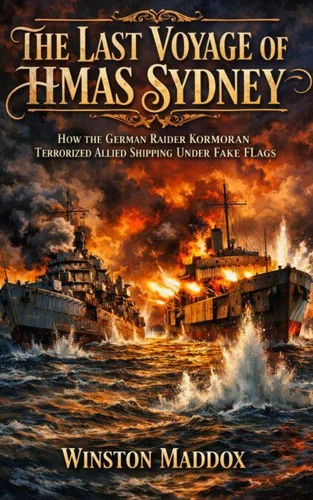
The Last Voyage of HMAS Sydney: How the German Raider Kormoran Terrorized Allied Shipping Under Fake Flags
Par :Formats :
Disponible dans votre compte client Decitre ou Furet du Nord dès validation de votre commande. Le format ePub est :
- Compatible avec une lecture sur My Vivlio (smartphone, tablette, ordinateur)
- Compatible avec une lecture sur liseuses Vivlio
- Pour les liseuses autres que Vivlio, vous devez utiliser le logiciel Adobe Digital Edition. Non compatible avec la lecture sur les liseuses Kindle, Remarkable et Sony
 , qui est-ce ?
Notre partenaire de plateforme de lecture numérique où vous retrouverez l'ensemble de vos ebooks gratuitement
Pour en savoir plus sur nos ebooks, consultez notre aide en ligne ici
C'est si simple ! Lisez votre ebook avec l'app Vivlio sur votre tablette, mobile ou ordinateur :

- FormatePub
- ISBN8235337312
- EAN9798235337312
- Date de parution16/07/2026
- Protection num.pas de protection
- Infos supplémentairesepub
- ÉditeurIoakim Ioakim
Résumé
What separates a tragic defeat from a perfect optical illusion? To the seasoned historian, the battles of the Second World War are often viewed through the lens of massive steel fleets, radar plotting rooms, and grand strategic maneuvers executed by unmistakable warships. Yet, deep in the isolated expanses of the Indian Ocean, the war was fought on entirely different, far more sinister terms. It was a war of masks, forgery, and lethal hesitation.
If you are a reader who doesn't just want to skim the surface of dates and casualty numbers, but wants to stand on a salt-sprayed deck, smelling the diesel fumes and feeling the agonizing tension of an identity check gone horribly wrong, then this book is the chronicle you have been waiting for. At the center of this historical post-mortem is the German auxiliary cruiser Kormoran-a massive diesel freighter converted in absolute secrecy into a heavily armed commerce destroyer.
She did not sail with the clean lines of a killer. Instead, she wandered the waves disguised as a harmless merchant cargo ship, complete with fake smoke funnels, moving walls, and a locker stuffed with the flags of neutral nations. For over a year, the Kormoran operated as a maritime phantom, stalking Allied supply lines, luring unsuspecting merchant captains close, and revealing her true colors only seconds before pulling the trigger.
It was a masterful, ruthless exercise in deception that violated the chivalry of the sea to achieve total tactical surprise. On the other side stood HMAS Sydney, a legendary Leander-class light cruiser, fresh from triumphs in the Mediterranean and manned by 645 elite sailors of the Royal Australian Navy. She was faster, better armored, and packed far more concentrated firepower than any converted merchantman could ever hope to carry.
Yet, on November 19, 1941, these two vastly different worlds collided off the coast of Western Australia. What happened over the course of the next hour remains an object lesson in psychological warfare and tactical vulnerability. It is a story of how a brilliant commander used an enemy's own caution and decency against them, closing a geographical trap until the distance between predator and prey was virtually non-existent.
Through meticulous analysis of survivors' testimonies, archival logs, and modern deep-sea wreckage forensics, this book reconstructs the frantic minutes of World War II's most shocking naval duel. You will experience the agonizing decisions on the bridge of the Sydney as she drew within point-blank range of a ship flying a friendly Dutch flag. You will feel the sudden shockwave as the Kormoran's disguised bulwarks dropped, unleashing a firestorm that turned a pristine warship into a drifting volcano.
This text strips away the sanitized mythology of naval warfare to deliver a raw, granular look at the mechanics of maritime deception, the limits of mid-century intelligence, and the catastrophic price of a single tactical mistake. This is not a book that merely recounts the past; it drops you directly into the cold, terrifying reality of a high-seas trapdoor war. It challenges what you know about naval doctrine, commanding psychology, and the thin line between victory and total annihilation.
When the smoke finally cleared that November evening, two shattered hulls sank into the dark abyss of the Indian Ocean, leaving behind a silence that would last for generations. Can a military force ever truly protect itself against an enemy that refuses to wear its own face?
If you are a reader who doesn't just want to skim the surface of dates and casualty numbers, but wants to stand on a salt-sprayed deck, smelling the diesel fumes and feeling the agonizing tension of an identity check gone horribly wrong, then this book is the chronicle you have been waiting for. At the center of this historical post-mortem is the German auxiliary cruiser Kormoran-a massive diesel freighter converted in absolute secrecy into a heavily armed commerce destroyer.
She did not sail with the clean lines of a killer. Instead, she wandered the waves disguised as a harmless merchant cargo ship, complete with fake smoke funnels, moving walls, and a locker stuffed with the flags of neutral nations. For over a year, the Kormoran operated as a maritime phantom, stalking Allied supply lines, luring unsuspecting merchant captains close, and revealing her true colors only seconds before pulling the trigger.
It was a masterful, ruthless exercise in deception that violated the chivalry of the sea to achieve total tactical surprise. On the other side stood HMAS Sydney, a legendary Leander-class light cruiser, fresh from triumphs in the Mediterranean and manned by 645 elite sailors of the Royal Australian Navy. She was faster, better armored, and packed far more concentrated firepower than any converted merchantman could ever hope to carry.
Yet, on November 19, 1941, these two vastly different worlds collided off the coast of Western Australia. What happened over the course of the next hour remains an object lesson in psychological warfare and tactical vulnerability. It is a story of how a brilliant commander used an enemy's own caution and decency against them, closing a geographical trap until the distance between predator and prey was virtually non-existent.
Through meticulous analysis of survivors' testimonies, archival logs, and modern deep-sea wreckage forensics, this book reconstructs the frantic minutes of World War II's most shocking naval duel. You will experience the agonizing decisions on the bridge of the Sydney as she drew within point-blank range of a ship flying a friendly Dutch flag. You will feel the sudden shockwave as the Kormoran's disguised bulwarks dropped, unleashing a firestorm that turned a pristine warship into a drifting volcano.
This text strips away the sanitized mythology of naval warfare to deliver a raw, granular look at the mechanics of maritime deception, the limits of mid-century intelligence, and the catastrophic price of a single tactical mistake. This is not a book that merely recounts the past; it drops you directly into the cold, terrifying reality of a high-seas trapdoor war. It challenges what you know about naval doctrine, commanding psychology, and the thin line between victory and total annihilation.
When the smoke finally cleared that November evening, two shattered hulls sank into the dark abyss of the Indian Ocean, leaving behind a silence that would last for generations. Can a military force ever truly protect itself against an enemy that refuses to wear its own face?