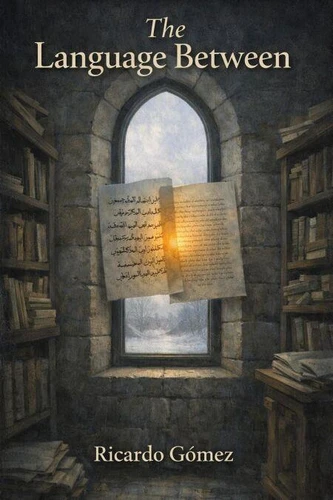
Granada, 1595. Workers excavating caves on the Sacromonte hill outside the city uncover a series of lead tablets - the Libros Plúmbeos, the Lead Books - bearing inscriptions in Arabic, Latin, and Castilian. The texts claim to be copied writings of the first bishop of Granada, an Arab disciple of St. James who arrived with the Gospel message in a form that could speak to both Christianity and Islam.
The ecclesiastical commission is eager. Rome is skeptical. And the only person who can work across all three registers is Nur, a Morisco woman who copies legal documents by day and reads Arabic privately, in a city that has made the practice dangerous. Nur is recruited to translate by Tomás de Olmedo, a Hieronymite monk assigned to the commission from the Monastery of Guadalupe. Tomás reads Latin; Nur reads Arabic; neither alone can reach what the tablets seem to contain.
What they discover - reading aloud to each other, each language filling the gaps the other leaves - is a third meaning. Not a synthesis. Not a compromise. Something that exists only in the interval between two voices, a space Nur's grandfather called the barzakh: the threshold between two things that are not yet resolved into one. The Language Between follows Nur across two movements. In the first, the tablets are still an open question - a text that has not yet been told what it must say.
In the second, the institutional pressure begins. Each version Nur produces is adjusted, reframed, and quietly corrected by men whose interests she cannot afford to challenge directly. What she is losing is not the translation. It is the space the translation had briefly opened. A Coda set in Rome in 1680 closes the historical record: the tablets declared apocryphal by the Vatican in 1642, transferred to Rome, held in the archives for nearly three centuries.
The knowledge that lived between two voices does not survive the filing system. The Libros Plúmbeos are real artifacts. They were discovered in 1595, debated for nearly fifty years, declared forgeries by Rome in 1642, and returned to Granada in 2000. Current scholarship agrees they were almost certainly fabricated - probably by Moriscos of the sixteenth century, as an attempt to create cultural space in a moment of systematic persecution.
This novel inhabits that attempt from the inside. For readers of Umberto Eco, Salman Rushdie, and Laila Lalami.
Granada, 1595. Workers excavating caves on the Sacromonte hill outside the city uncover a series of lead tablets - the Libros Plúmbeos, the Lead Books - bearing inscriptions in Arabic, Latin, and Castilian. The texts claim to be copied writings of the first bishop of Granada, an Arab disciple of St. James who arrived with the Gospel message in a form that could speak to both Christianity and Islam.
The ecclesiastical commission is eager. Rome is skeptical. And the only person who can work across all three registers is Nur, a Morisco woman who copies legal documents by day and reads Arabic privately, in a city that has made the practice dangerous. Nur is recruited to translate by Tomás de Olmedo, a Hieronymite monk assigned to the commission from the Monastery of Guadalupe. Tomás reads Latin; Nur reads Arabic; neither alone can reach what the tablets seem to contain.
What they discover - reading aloud to each other, each language filling the gaps the other leaves - is a third meaning. Not a synthesis. Not a compromise. Something that exists only in the interval between two voices, a space Nur's grandfather called the barzakh: the threshold between two things that are not yet resolved into one. The Language Between follows Nur across two movements. In the first, the tablets are still an open question - a text that has not yet been told what it must say.
In the second, the institutional pressure begins. Each version Nur produces is adjusted, reframed, and quietly corrected by men whose interests she cannot afford to challenge directly. What she is losing is not the translation. It is the space the translation had briefly opened. A Coda set in Rome in 1680 closes the historical record: the tablets declared apocryphal by the Vatican in 1642, transferred to Rome, held in the archives for nearly three centuries.
The knowledge that lived between two voices does not survive the filing system. The Libros Plúmbeos are real artifacts. They were discovered in 1595, debated for nearly fifty years, declared forgeries by Rome in 1642, and returned to Granada in 2000. Current scholarship agrees they were almost certainly fabricated - probably by Moriscos of the sixteenth century, as an attempt to create cultural space in a moment of systematic persecution.
This novel inhabits that attempt from the inside. For readers of Umberto Eco, Salman Rushdie, and Laila Lalami.