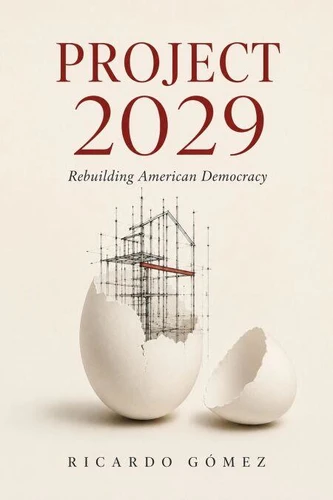
A broken egg cannot go back in the shell. But with what is left inside, you can still build something better. In 1864, with the war going badly and his own reelection in doubt, Abraham Lincoln answered the men who wanted him to stop the fighting and hand the country back exactly as it was. Broken eggs, he wrote, cannot be mended. A century and a half later, that hard image gives this book its shape.
Project 2029 is a novelist's response to the dismantling of American democracy. Ricardo Gómez, born in Canada, raised in Colombia, and settled in the Pacific Northwest, watches that process from a triple belonging and with an uncomfortable advantage: in Latin America, we have already seen this movie. Contempt for institutions, politics turned into spectacle, the opponent recast as an internal enemy, justice treated as persecution.
The script is recognizable from one country to the next. Against Project 2025, the demolition plan the Heritage Foundation wrote out loud, Gómez proposes thinking about a Project 2029: an agenda of reconstruction rather than a list of progressive wishes, as serious, as structurally ambitious, and as patient as the plan it means to undo. Rebuild, do not restore. Each chapter braids two voices. One lays out the facts, sourced and checkable: the rules of power, the economy, rights, information, memory, faith, the place of the United States in the world.
The other brings in scenes from the author's own novels, among them The Tides of Freedom and The Comandante's Shadow, because a statistic can say that the top one percent owns more than the bottom ninety, and only a novel can say what it feels like to be the man who goes down into the mine that is not his. The book begins outside, with a letter, and ends outside, with another. A literary essay on how democracies break, why repairing them is not enough, and what it would take to build something able to withstand the next tremor.
For readers of Steven Levitsky and Daniel Ziblatt's How Democracies Die, Timothy Snyder's On Tyranny, Anne Applebaum's Twilight of Democracy, and Ece Temelkuran's How to Lose a Country.
A broken egg cannot go back in the shell. But with what is left inside, you can still build something better. In 1864, with the war going badly and his own reelection in doubt, Abraham Lincoln answered the men who wanted him to stop the fighting and hand the country back exactly as it was. Broken eggs, he wrote, cannot be mended. A century and a half later, that hard image gives this book its shape.
Project 2029 is a novelist's response to the dismantling of American democracy. Ricardo Gómez, born in Canada, raised in Colombia, and settled in the Pacific Northwest, watches that process from a triple belonging and with an uncomfortable advantage: in Latin America, we have already seen this movie. Contempt for institutions, politics turned into spectacle, the opponent recast as an internal enemy, justice treated as persecution.
The script is recognizable from one country to the next. Against Project 2025, the demolition plan the Heritage Foundation wrote out loud, Gómez proposes thinking about a Project 2029: an agenda of reconstruction rather than a list of progressive wishes, as serious, as structurally ambitious, and as patient as the plan it means to undo. Rebuild, do not restore. Each chapter braids two voices. One lays out the facts, sourced and checkable: the rules of power, the economy, rights, information, memory, faith, the place of the United States in the world.
The other brings in scenes from the author's own novels, among them The Tides of Freedom and The Comandante's Shadow, because a statistic can say that the top one percent owns more than the bottom ninety, and only a novel can say what it feels like to be the man who goes down into the mine that is not his. The book begins outside, with a letter, and ends outside, with another. A literary essay on how democracies break, why repairing them is not enough, and what it would take to build something able to withstand the next tremor.
For readers of Steven Levitsky and Daniel Ziblatt's How Democracies Die, Timothy Snyder's On Tyranny, Anne Applebaum's Twilight of Democracy, and Ece Temelkuran's How to Lose a Country.