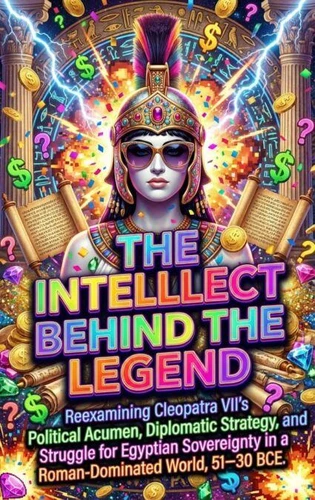
The Intellect Behind the Legend. Reexamining Cleopatra VII's Political Acumen, Diplomatic Strategy, and Struggle for Egyptian Sovereignty in a Roman-Dominated World, 51–30 BCE
Par :Formats :
Disponible dans votre compte client Decitre ou Furet du Nord dès validation de votre commande. Le format ePub est :
- Compatible avec une lecture sur My Vivlio (smartphone, tablette, ordinateur)
- Compatible avec une lecture sur liseuses Vivlio
- Pour les liseuses autres que Vivlio, vous devez utiliser le logiciel Adobe Digital Edition. Non compatible avec la lecture sur les liseuses Kindle, Remarkable et Sony
 , qui est-ce ?
Notre partenaire de plateforme de lecture numérique où vous retrouverez l'ensemble de vos ebooks gratuitement
Pour en savoir plus sur nos ebooks, consultez notre aide en ligne ici
C'est si simple ! Lisez votre ebook avec l'app Vivlio sur votre tablette, mobile ou ordinateur :

- Nombre de pages211
- FormatePub
- ISBN978-3-565-19899-3
- EAN9783565198993
- Date de parution27/01/2026
- Protection num.pas de protection
- Taille2 Mo
- Infos supplémentairesepub
- ÉditeurEmphaloz Publishing House
Résumé
Cleopatra VII has been reduced in popular imagination to a figure of seduction and romantic tragedy-a distortion that obscures her actual achievement: maintaining Egyptian independence for two decades through brilliant diplomacy, multilingual negotiation, economic leverage, and strategic alliances in an era when Rome systematically absorbed Mediterranean kingdoms. Her story is not about beauty manipulating powerful men, but about intellect navigating impossible geopolitical constraints.
This book reconstructs Cleopatra's political career through the decisions that sustained Ptolemaic rule against overwhelming odds.
It examines her early power struggle with sibling rivals, her cultivation of Egyptian religious legitimacy while governing a Greek dynasty, her economic reforms that stabilized grain exports Rome desperately needed, and her calculated alliances with Julius Caesar and Mark Antony-partnerships based on mutual strategic advantage, not romantic fantasy. It explores how she leveraged Egypt's wealth to fund military campaigns, how she presented herself differently to Egyptian, Greek, and Roman audiences, and how Roman propaganda systematically erased her political sophistication. Drawing on contemporary sources, coins bearing her image, Plutarch's accounts filtered through Roman bias, and archaeological evidence from Alexandria, it reveals the structural challenges she faced: a kingdom surrounded by Roman client states, treasury pressures from supporting allies' wars, and the fundamental impossibility of maintaining sovereignty when Rome's civil wars required Egyptian resources.
It analyzes how Octavian's propaganda transformed a political adversary into an exotic threat to Roman masculinity, and how that distortion persisted through centuries. This is an examination of how a capable ruler's legacy was rewritten to serve the narratives of those who destroyed her.
It examines her early power struggle with sibling rivals, her cultivation of Egyptian religious legitimacy while governing a Greek dynasty, her economic reforms that stabilized grain exports Rome desperately needed, and her calculated alliances with Julius Caesar and Mark Antony-partnerships based on mutual strategic advantage, not romantic fantasy. It explores how she leveraged Egypt's wealth to fund military campaigns, how she presented herself differently to Egyptian, Greek, and Roman audiences, and how Roman propaganda systematically erased her political sophistication. Drawing on contemporary sources, coins bearing her image, Plutarch's accounts filtered through Roman bias, and archaeological evidence from Alexandria, it reveals the structural challenges she faced: a kingdom surrounded by Roman client states, treasury pressures from supporting allies' wars, and the fundamental impossibility of maintaining sovereignty when Rome's civil wars required Egyptian resources.
It analyzes how Octavian's propaganda transformed a political adversary into an exotic threat to Roman masculinity, and how that distortion persisted through centuries. This is an examination of how a capable ruler's legacy was rewritten to serve the narratives of those who destroyed her.