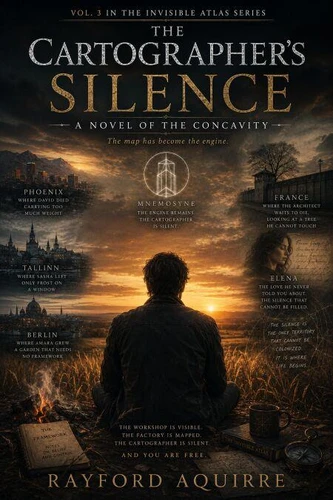
Rayford Aquirre has spent fifteen years mapping the invisible. He has traced the architecture of belief from the concavities of grief to the factories of certainty. He has shown you the workshop. He has walked you through the territory. And now he must tell you what he has never told anyone. The map has become the engine. In this third volume of The Invisible Atlas, the cartographer returns to the places that broke him.
Phoenix, where David died carrying too much weight. Tallinn, where Sasha left only frost on a window. Berlin, where Amara grew a garden that needs no framework. And a prison hospital in France, where the architect who built Mnemosyne waits to die, looking at a tree he cannot touch. Between these journeys, Rayford confesses the shadow that falls across everything he has written. The framework that was meant to expose manipulation has become its own form of colonization.
The readers who learned to see have become enclosed by their own clarity. The cartographer who set out to free the world has built a new machinery of belief. And then there is Elena. The lover he has never told you about. The translator who taught him that the concavity is where love lives. The woman who died without a theory, without a map, without a framework, leaving only the silence that words cannot fill.
This is not a book about answers. It is a book about stopping. About burning the notebook in a field of wheat. About setting the reader down. About walking into the sunset without looking back. About the discipline of attention without classification, presence without analysis, love without understanding. The Cartographer's Silence is a farewell and a beginning. A novel written in the second person, addressed to you, the reader who has carried the weight on his shoulder.
A meditation on the cost of clear sight. A reckoning with the engine that reveals itself. And finally, an invitation to close the book, walk outside, and live an unmapped life. Because the silence is not the absence of sound. It is the presence of attention without object. It is the only territory that cannot be colonized. It is where life begins. The workshop is visible. The factory is mapped. The cartographer is silent.
And you are free.
Rayford Aquirre has spent fifteen years mapping the invisible. He has traced the architecture of belief from the concavities of grief to the factories of certainty. He has shown you the workshop. He has walked you through the territory. And now he must tell you what he has never told anyone. The map has become the engine. In this third volume of The Invisible Atlas, the cartographer returns to the places that broke him.
Phoenix, where David died carrying too much weight. Tallinn, where Sasha left only frost on a window. Berlin, where Amara grew a garden that needs no framework. And a prison hospital in France, where the architect who built Mnemosyne waits to die, looking at a tree he cannot touch. Between these journeys, Rayford confesses the shadow that falls across everything he has written. The framework that was meant to expose manipulation has become its own form of colonization.
The readers who learned to see have become enclosed by their own clarity. The cartographer who set out to free the world has built a new machinery of belief. And then there is Elena. The lover he has never told you about. The translator who taught him that the concavity is where love lives. The woman who died without a theory, without a map, without a framework, leaving only the silence that words cannot fill.
This is not a book about answers. It is a book about stopping. About burning the notebook in a field of wheat. About setting the reader down. About walking into the sunset without looking back. About the discipline of attention without classification, presence without analysis, love without understanding. The Cartographer's Silence is a farewell and a beginning. A novel written in the second person, addressed to you, the reader who has carried the weight on his shoulder.
A meditation on the cost of clear sight. A reckoning with the engine that reveals itself. And finally, an invitation to close the book, walk outside, and live an unmapped life. Because the silence is not the absence of sound. It is the presence of attention without object. It is the only territory that cannot be colonized. It is where life begins. The workshop is visible. The factory is mapped. The cartographer is silent.
And you are free.