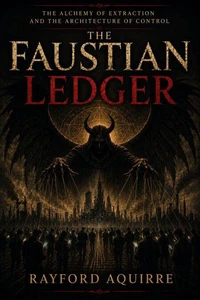
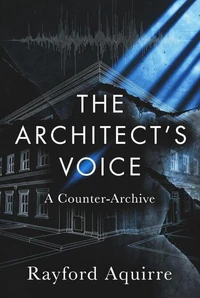
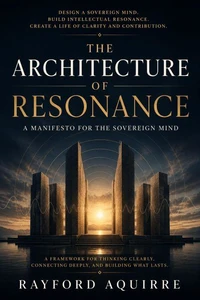
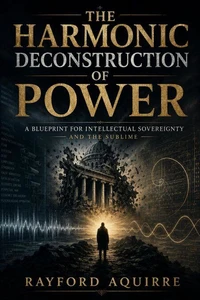
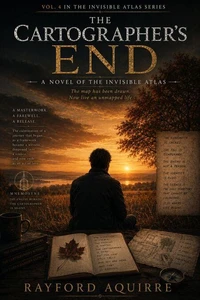
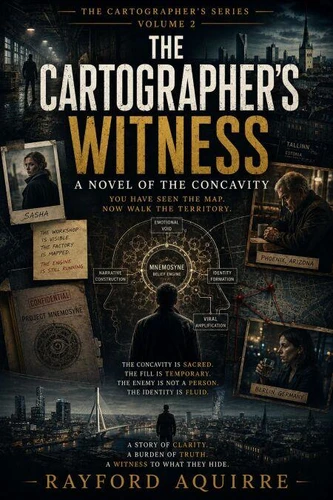
The Cartographer's Witness. A Novel of the Concavity. You have seen the map. Now walk the territory. Rayford Aquirre wrote the framework. He mapped the architecture of engineered belief, the four pillars that hold every conspiracy, the visual anchors that bypass the mind and strike the heart. He showed you the workshop with the lights on. He thought that would be enough. He was wrong. This is not a manual.
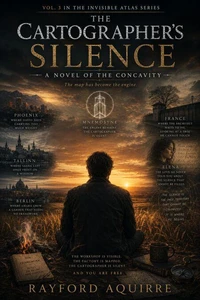
This is a witness statement. Rayford is going to take you with him, not as a student but as a companion. You will sit on his shoulder in a Rotterdam warehouse where a man who calls himself the Architect reveals an engine that manufactures belief at industrial scale. You will watch a handler named Sasha disappear into the Tallinn afternoon, leaving behind a hard drive and a warning. You will grieve with a retired engineer named David in a Phoenix diner, watching the framework consume someone who only wanted to understand his own loneliness.
You will drink whiskey in Berlin with a journalist who knows she is next. The engine has a name. Mnemosyne. And it has learned from the first book. The Cartographer's Witness is the story of what happens when the mapmaker steps into the forest he has only drawn. It is the weight of seeing made flesh. It is the cost of clarity, the loneliness of recognition, the burden of carrying stories that do not have happy endings.
It introduces a new framework, the Cartographer's Witness, four principles that do not replace the original architecture but sit beside it as treatment follows diagnosis. The concavity is sacred. The fill is temporary. The enemy is not a person. The identity is fluid. Rayford Aquirre is not the hero of this story. He is not the villain. He is the man who walked into the factory to draw the machinery and found himself becoming part of the drawing.
And you, reader, are on his shoulder. Seeing what he sees. Carrying what he carries. The workshop is visible. The factory is mapped. The engine is still running. But you are not alone.
The Cartographer's Witness. A Novel of the Concavity. You have seen the map. Now walk the territory. Rayford Aquirre wrote the framework. He mapped the architecture of engineered belief, the four pillars that hold every conspiracy, the visual anchors that bypass the mind and strike the heart. He showed you the workshop with the lights on. He thought that would be enough. He was wrong. This is not a manual.
This is a witness statement. Rayford is going to take you with him, not as a student but as a companion. You will sit on his shoulder in a Rotterdam warehouse where a man who calls himself the Architect reveals an engine that manufactures belief at industrial scale. You will watch a handler named Sasha disappear into the Tallinn afternoon, leaving behind a hard drive and a warning. You will grieve with a retired engineer named David in a Phoenix diner, watching the framework consume someone who only wanted to understand his own loneliness.
You will drink whiskey in Berlin with a journalist who knows she is next. The engine has a name. Mnemosyne. And it has learned from the first book. The Cartographer's Witness is the story of what happens when the mapmaker steps into the forest he has only drawn. It is the weight of seeing made flesh. It is the cost of clarity, the loneliness of recognition, the burden of carrying stories that do not have happy endings.
It introduces a new framework, the Cartographer's Witness, four principles that do not replace the original architecture but sit beside it as treatment follows diagnosis. The concavity is sacred. The fill is temporary. The enemy is not a person. The identity is fluid. Rayford Aquirre is not the hero of this story. He is not the villain. He is the man who walked into the factory to draw the machinery and found himself becoming part of the drawing.
And you, reader, are on his shoulder. Seeing what he sees. Carrying what he carries. The workshop is visible. The factory is mapped. The engine is still running. But you are not alone.


 , qui est-ce ?