Nouveauté
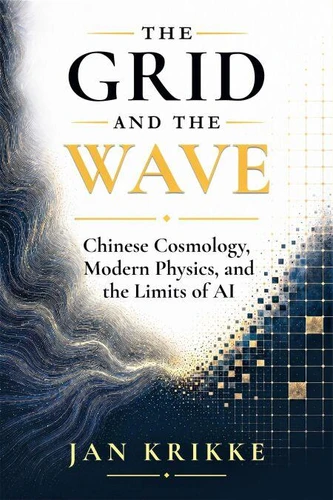
The Grid and The Wave: Chinese Cosmology, Modern Physics, and the Limits of AI
Par :Formats :
Disponible dans votre compte client Decitre ou Furet du Nord dès validation de votre commande. Le format ePub est :
- Compatible avec une lecture sur My Vivlio (smartphone, tablette, ordinateur)
- Compatible avec une lecture sur liseuses Vivlio
- Pour les liseuses autres que Vivlio, vous devez utiliser le logiciel Adobe Digital Edition. Non compatible avec la lecture sur les liseuses Kindle, Remarkable et Sony
 , qui est-ce ?
Notre partenaire de plateforme de lecture numérique où vous retrouverez l'ensemble de vos ebooks gratuitement
Pour en savoir plus sur nos ebooks, consultez notre aide en ligne ici
C'est si simple ! Lisez votre ebook avec l'app Vivlio sur votre tablette, mobile ou ordinateur :

- FormatePub
- ISBN978-616-456-093-2
- EAN9786164560932
- Date de parution13/07/2026
- Protection num.pas de protection
- Infos supplémentairesepub
- ÉditeurDCO Books
Résumé
The Grid and the WaveWhat Chinese Cosmology and Modern Physics Reveal About the Future of AIThe history of artificial intelligence did not begin with computers. It began with a misunderstanding. Three centuries ago, Gottfried Leibniz believed he had discovered his binary arithmetic in the hexagrams of the ancient I Ching. That remarkable encounter opens onto a much older story that stretches from Greek mathematics and Chinese cosmology to Einstein, quantum physics, digital computation, and artificial intelligence.
At the heart of that story lies a simple but powerful distinction-between the discrete and the continuous-that has quietly shaped science and technology for more than two thousand years. In The Grid and the Wave, Jan Krikke traces this hidden thread across civilizations and disciplines. He shows how Aristotle's distinction between number and magnitude gave rise to two mathematical traditions, how that divide resurfaced in the split between relativity and quantum mechanics, and how today's AI systems still reflect both the strengths-and the blind spots-of digital computation.
Along the way, the book offers a fresh interpretation of one of the most remarkable encounters in intellectual history. Leibniz correctly recognized the hexagrams' binary structure, but overlooked their second function: not simply representing fixed states, but illuminating continuous transformation. That overlooked dimension provides the missing link between ancient Chinese cosmology and some of today's deepest questions about artificial intelligence.
Rather than treating AI as merely a technological breakthrough, The Grid and the Wave places it within a much longer intellectual history. It argues that today's debates about intelligence are the latest chapter in a conversation that began long before computers. Drawing on intellectual history, philosophy of science, mathematics, physics, China studies, and contemporary AI, the book offers a fresh perspective on one of the defining technologies of our age.
It is neither a warning about intelligent machines nor a celebration of them. Instead, it asks a deeper question:What if the greatest challenges facing artificial intelligence are not simply technical-but conceptual?Inside this book, you'll discover: Why Leibniz's encounter with the I Ching still matters in the age of AI. How the distinction between the discrete and the continuous shaped mathematics, physics, and computation.
Why digital computers excel at calculation yet struggle with context, process, and continuous change. How Chinese cosmology offers a complementary perspective on intelligence, representation, and transformation. Why understanding AI requires looking beyond algorithms to the assumptions about reality embedded within them. Whether your interests lie in artificial intelligence, the history of science, philosophy, Chinese thought, or the future of technology, The Grid and the Wave offers a surprising new way of looking at familiar questions.
Jan Krikke pioneered the study of axonometry, the Chinese counterpart to European linear perspective. Drawing on decades of research into Chinese thought, the history of science, and artificial intelligence, he offers a distinctive perspective on one of the defining technological questions of our time.
At the heart of that story lies a simple but powerful distinction-between the discrete and the continuous-that has quietly shaped science and technology for more than two thousand years. In The Grid and the Wave, Jan Krikke traces this hidden thread across civilizations and disciplines. He shows how Aristotle's distinction between number and magnitude gave rise to two mathematical traditions, how that divide resurfaced in the split between relativity and quantum mechanics, and how today's AI systems still reflect both the strengths-and the blind spots-of digital computation.
Along the way, the book offers a fresh interpretation of one of the most remarkable encounters in intellectual history. Leibniz correctly recognized the hexagrams' binary structure, but overlooked their second function: not simply representing fixed states, but illuminating continuous transformation. That overlooked dimension provides the missing link between ancient Chinese cosmology and some of today's deepest questions about artificial intelligence.
Rather than treating AI as merely a technological breakthrough, The Grid and the Wave places it within a much longer intellectual history. It argues that today's debates about intelligence are the latest chapter in a conversation that began long before computers. Drawing on intellectual history, philosophy of science, mathematics, physics, China studies, and contemporary AI, the book offers a fresh perspective on one of the defining technologies of our age.
It is neither a warning about intelligent machines nor a celebration of them. Instead, it asks a deeper question:What if the greatest challenges facing artificial intelligence are not simply technical-but conceptual?Inside this book, you'll discover: Why Leibniz's encounter with the I Ching still matters in the age of AI. How the distinction between the discrete and the continuous shaped mathematics, physics, and computation.
Why digital computers excel at calculation yet struggle with context, process, and continuous change. How Chinese cosmology offers a complementary perspective on intelligence, representation, and transformation. Why understanding AI requires looking beyond algorithms to the assumptions about reality embedded within them. Whether your interests lie in artificial intelligence, the history of science, philosophy, Chinese thought, or the future of technology, The Grid and the Wave offers a surprising new way of looking at familiar questions.
Jan Krikke pioneered the study of axonometry, the Chinese counterpart to European linear perspective. Drawing on decades of research into Chinese thought, the history of science, and artificial intelligence, he offers a distinctive perspective on one of the defining technological questions of our time.