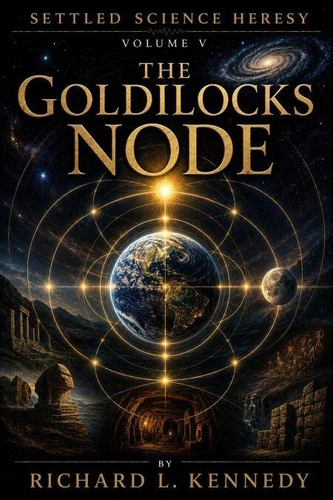
Earth is often described as a planet. Technically accurate. But perhaps incomplete. In The Goldilocks Node, Richard L. Kennedy examines Earth as something far more remarkable: a rare convergence of countless relationships that together created the conditions for life, intelligence, knowledge, and wonder. Beginning with an ordinary acre of grassland, Kennedy guides readers on a journey through the forces and systems that make Earth unique.
The stabilizing influence of the Moon. The protection of the magnetic field. The atmosphere, oceans, geology, ecosystems, and microbial world. Each chapter reveals another layer of complexity and another thread in an intricate tapestry stretching across scales from microscopic life to the cosmos itself. As the journey unfolds, the focus shifts from individual parts to the relationships connecting them.
Intelligence emerges. Curiosity awakens. Knowledge accumulates. Humanity begins asking questions about the remarkable world that produced it. Ultimately, The Goldilocks Node proposes a different way of viewing Earth-not as a collection of separate components, but as a harmony composed of harmonies. A symphony of interconnected influences that, together, created a place where the universe became capable of observing itself.
Whether approached as science, philosophy, systems thinking, or a meditation on humanity's place in the cosmos, The Goldilocks Node invites readers to step back from isolated details and consider the larger pattern. A place not too hot. Not too cold. Not too hard. Not too soft. A place that is just right.
Earth is often described as a planet. Technically accurate. But perhaps incomplete. In The Goldilocks Node, Richard L. Kennedy examines Earth as something far more remarkable: a rare convergence of countless relationships that together created the conditions for life, intelligence, knowledge, and wonder. Beginning with an ordinary acre of grassland, Kennedy guides readers on a journey through the forces and systems that make Earth unique.
The stabilizing influence of the Moon. The protection of the magnetic field. The atmosphere, oceans, geology, ecosystems, and microbial world. Each chapter reveals another layer of complexity and another thread in an intricate tapestry stretching across scales from microscopic life to the cosmos itself. As the journey unfolds, the focus shifts from individual parts to the relationships connecting them.
Intelligence emerges. Curiosity awakens. Knowledge accumulates. Humanity begins asking questions about the remarkable world that produced it. Ultimately, The Goldilocks Node proposes a different way of viewing Earth-not as a collection of separate components, but as a harmony composed of harmonies. A symphony of interconnected influences that, together, created a place where the universe became capable of observing itself.
Whether approached as science, philosophy, systems thinking, or a meditation on humanity's place in the cosmos, The Goldilocks Node invites readers to step back from isolated details and consider the larger pattern. A place not too hot. Not too cold. Not too hard. Not too soft. A place that is just right.

 , qui est-ce ?