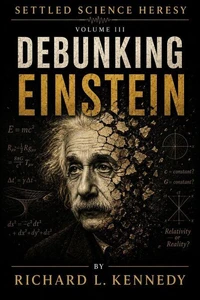
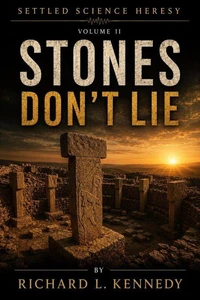
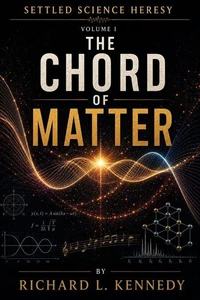
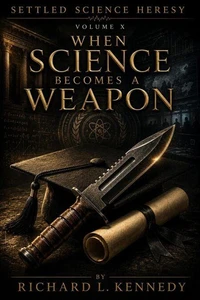
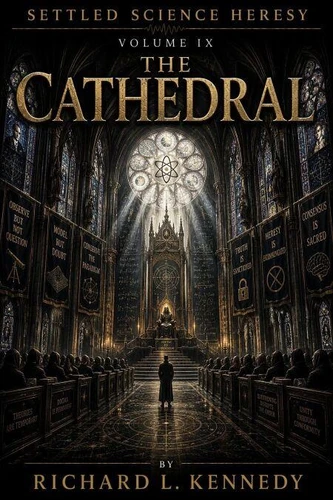
Science is often presented as humanity's most reliable path to truth. But what happens when the institutions built to pursue truth become invested in preserving their own foundations?In The Cathedral, Richard L. Kennedy examines the architecture of modern scientific authority through the ideas of Karl Popper, Thomas Kuhn, Isaac Newton, Arthur Eddington, and others. Moving from cosmology to archaeology, from dark matter to Göbekli Tepe, from peer review to academic credentialing, he asks a deceptively simple question:What evidence would be allowed to challenge the foundations of accepted knowledge?Through a series of accessible, thought-provoking chapters, Kennedy explores how paradigms are established, defended, and transmitted across generations.
He examines the role of consensus, institutional incentives, professional specialization, and the social structures that shape what questions are asked-and which questions are quietly set aside. Part philosophy of science, part historical investigation, and part cultural critique, The Cathedral challenges readers to distinguish between observation and explanation, evidence and authority, discovery and institutional preservation.
Whether you agree with its conclusions or not, The Cathedral invites readers to revisit one of science's oldest principles:The willingness to question even its most cherished assumptions.
Science is often presented as humanity's most reliable path to truth. But what happens when the institutions built to pursue truth become invested in preserving their own foundations?In The Cathedral, Richard L. Kennedy examines the architecture of modern scientific authority through the ideas of Karl Popper, Thomas Kuhn, Isaac Newton, Arthur Eddington, and others. Moving from cosmology to archaeology, from dark matter to Göbekli Tepe, from peer review to academic credentialing, he asks a deceptively simple question:What evidence would be allowed to challenge the foundations of accepted knowledge?Through a series of accessible, thought-provoking chapters, Kennedy explores how paradigms are established, defended, and transmitted across generations.
He examines the role of consensus, institutional incentives, professional specialization, and the social structures that shape what questions are asked-and which questions are quietly set aside. Part philosophy of science, part historical investigation, and part cultural critique, The Cathedral challenges readers to distinguish between observation and explanation, evidence and authority, discovery and institutional preservation.
Whether you agree with its conclusions or not, The Cathedral invites readers to revisit one of science's oldest principles:The willingness to question even its most cherished assumptions.


 , qui est-ce ?