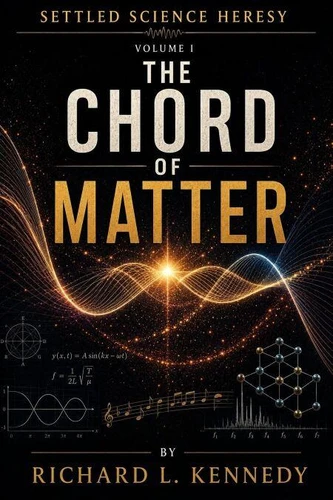
What if the periodic table is not just a chart of elements, but a musical scale of matter?In Settled Science Heresy, Volume I: The Chord of Matter, Richard L. Kennedy offers a bold, accessible challenge to the way chemistry, physics, and cosmology are usually taught. Beginning with two familiar classroom tables-the periodic table and the musical scale-Kennedy argues that both reveal the same repeating structure: cycles, octaves, harmonics, tension, and resolution.
Hydrogen becomes the fundamental note. Helium becomes the octave. Atomic shells become standing waves. Chemical reactions become movements from dissonance to resolution. Salt, water, carbon, oxygen, stars, fusion, galaxies, superconductors, and even cold fusion are reconsidered through one organizing idea: matter behaves like music because matter is structured by vibration. This is not a conventional science textbook.
It is a heretical framework written for curious readers willing to question whether "settled science" has mistaken description for explanation. Kennedy does not claim the final word; he offers a pattern, a lens, and a set of testable possibilities. Written for future students, independent thinkers, science skeptics, and readers fascinated by resonance, cymatics, harmony, and the hidden order of nature, The Chord of Matter begins a twelve-volume journey into a different way of seeing reality.
What if the periodic table is not just a chart of elements, but a musical scale of matter?In Settled Science Heresy, Volume I: The Chord of Matter, Richard L. Kennedy offers a bold, accessible challenge to the way chemistry, physics, and cosmology are usually taught. Beginning with two familiar classroom tables-the periodic table and the musical scale-Kennedy argues that both reveal the same repeating structure: cycles, octaves, harmonics, tension, and resolution.
Hydrogen becomes the fundamental note. Helium becomes the octave. Atomic shells become standing waves. Chemical reactions become movements from dissonance to resolution. Salt, water, carbon, oxygen, stars, fusion, galaxies, superconductors, and even cold fusion are reconsidered through one organizing idea: matter behaves like music because matter is structured by vibration. This is not a conventional science textbook.
It is a heretical framework written for curious readers willing to question whether "settled science" has mistaken description for explanation. Kennedy does not claim the final word; he offers a pattern, a lens, and a set of testable possibilities. Written for future students, independent thinkers, science skeptics, and readers fascinated by resonance, cymatics, harmony, and the hidden order of nature, The Chord of Matter begins a twelve-volume journey into a different way of seeing reality.

 , qui est-ce ?