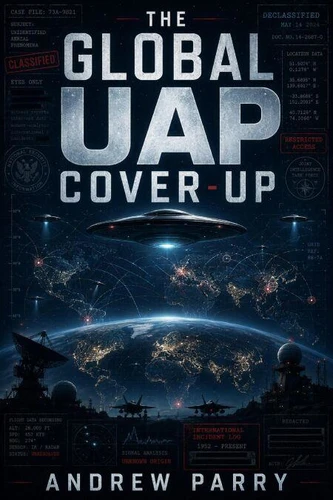
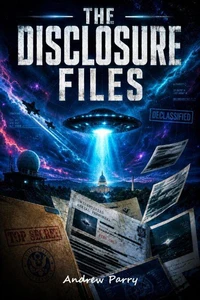
THE GLOBAL UAP COVER-UPFor more than seventy years, unidentified anomalous phenomena have been reported above cities, military bases, nuclear installations, deserts, oceans, schools, airports, and remote communities across the world. Pilots have pursued unknown objects. Radar operators have tracked unexplained targets. Children have described beings near their playgrounds. Governments have collected reports, scrambled aircraft, opened investigations, classified records, and then told the public there was little to see.
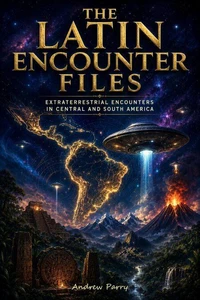
But the phenomenon was never confined to the United States. The Global UAP Cover-Up takes the reader beyond Roswell, Area 51, and the Pentagon to examine the worldwide history of unexplained aerial encounters and the international systems of secrecy that surrounded them. From Britain's Ministry of Defense files and France's scientific investigations to Belgium's triangular craft, Soviet military studies, Brazil's Night of the UFOs, Peru's La Joya interception, Australia's hidden defense records, Africa's forgotten witnesses, and the Ariel School encounter in Zimbabwe, this book reveals a mystery that has crossed every political, cultural, and geographic boundary.
Governments have not all responded in the same way. Some created official investigative offices. Some released thousands of pages of military reports. Others denied interest while quietly collecting testimony through intelligence, aviation, police, and defense channels. Many records were destroyed, scattered across agencies, hidden under unfamiliar classifications, or transferred into archives only decades later.
In countries shaped by colonialism, war, political instability, weak archival systems, or restricted media, entire histories of sightings may have disappeared. What emerges is not one simple conspiracy, but a global architecture of silence. Military alliances share radar information, intelligence assessments, satellite data, and air-defense reports across borders. Governments protect sensor capabilities, classified aircraft, foreign partnerships, and national-security vulnerabilities.
Pilots fear professional consequences. Scientists avoid ridicule. Political leaders admit uncertainty only reluctantly. Each institution may remain silent for its own reason, yet the combined result resembles a worldwide agreement not to reveal the full truth. This book examines whether that silence is centrally coordinated, competitively maintained, or produced by overlapping systems of secrecy. It asks whether governments are hiding proof of non-human intelligence, protecting advanced human technology, concealing their inability to control national airspace, or managing a reality they do not fully understand.
Former defense ministers, generals, fighter pilots, scientists, intelligence officers, and politicians have all challenged official silence. Some claimed firsthand encounters. Others described hidden programmes, classified briefings, missing files, or restricted investigations. Their testimony is important, but authority alone is not proof. The central question remains the same: where are the records, sensor data, physical materials, and independently verifiable evidence?The Global UAP Cover-Up is not a book of unquestioning belief.
It is an investigation into power, secrecy, testimony, and the worldwide struggle to establish what governments truly know. It follows the evidence through archives, military commands, intelligence structures, political hearings, scientific institutions, and the memories of witnesses who refused to remain silent. The files are opening. The witnesses are speaking. The silence is weakening. And the truth may be far more global than we have ever been told.
THE GLOBAL UAP COVER-UPFor more than seventy years, unidentified anomalous phenomena have been reported above cities, military bases, nuclear installations, deserts, oceans, schools, airports, and remote communities across the world. Pilots have pursued unknown objects. Radar operators have tracked unexplained targets. Children have described beings near their playgrounds. Governments have collected reports, scrambled aircraft, opened investigations, classified records, and then told the public there was little to see.
But the phenomenon was never confined to the United States. The Global UAP Cover-Up takes the reader beyond Roswell, Area 51, and the Pentagon to examine the worldwide history of unexplained aerial encounters and the international systems of secrecy that surrounded them. From Britain's Ministry of Defense files and France's scientific investigations to Belgium's triangular craft, Soviet military studies, Brazil's Night of the UFOs, Peru's La Joya interception, Australia's hidden defense records, Africa's forgotten witnesses, and the Ariel School encounter in Zimbabwe, this book reveals a mystery that has crossed every political, cultural, and geographic boundary.
Governments have not all responded in the same way. Some created official investigative offices. Some released thousands of pages of military reports. Others denied interest while quietly collecting testimony through intelligence, aviation, police, and defense channels. Many records were destroyed, scattered across agencies, hidden under unfamiliar classifications, or transferred into archives only decades later.
In countries shaped by colonialism, war, political instability, weak archival systems, or restricted media, entire histories of sightings may have disappeared. What emerges is not one simple conspiracy, but a global architecture of silence. Military alliances share radar information, intelligence assessments, satellite data, and air-defense reports across borders. Governments protect sensor capabilities, classified aircraft, foreign partnerships, and national-security vulnerabilities.
Pilots fear professional consequences. Scientists avoid ridicule. Political leaders admit uncertainty only reluctantly. Each institution may remain silent for its own reason, yet the combined result resembles a worldwide agreement not to reveal the full truth. This book examines whether that silence is centrally coordinated, competitively maintained, or produced by overlapping systems of secrecy. It asks whether governments are hiding proof of non-human intelligence, protecting advanced human technology, concealing their inability to control national airspace, or managing a reality they do not fully understand.
Former defense ministers, generals, fighter pilots, scientists, intelligence officers, and politicians have all challenged official silence. Some claimed firsthand encounters. Others described hidden programmes, classified briefings, missing files, or restricted investigations. Their testimony is important, but authority alone is not proof. The central question remains the same: where are the records, sensor data, physical materials, and independently verifiable evidence?The Global UAP Cover-Up is not a book of unquestioning belief.
It is an investigation into power, secrecy, testimony, and the worldwide struggle to establish what governments truly know. It follows the evidence through archives, military commands, intelligence structures, political hearings, scientific institutions, and the memories of witnesses who refused to remain silent. The files are opening. The witnesses are speaking. The silence is weakening. And the truth may be far more global than we have ever been told.