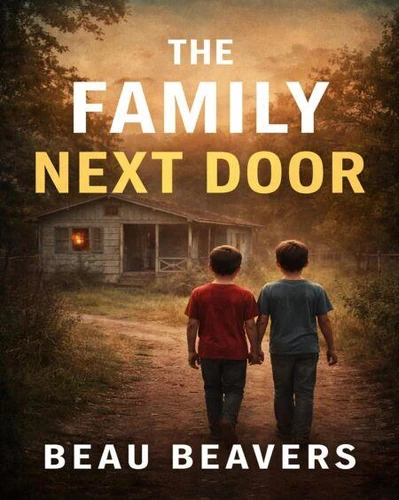
The Family Next Door is a deeply reflective literary memoir about friendship, environment, accountability, and the quiet ways childhood shapes adulthood. Through the story of his lifelong friendship with a troubled boy named Eli, Beau Beavers examines how family culture, boundaries, responsibility, and consistency can determine the direction of a person's life long before anyone recognizes the consequences.
Growing up in a rural town, Beau becomes inseparable from Eli, the grandson of the infamous Cal Boone-a charismatic rodeo clown whose larger-than-life personality makes him a local legend. Cal rides bulls through town, keeps dangerous exotic animals on his property, burns fields for entertainment, and turns recklessness into performance. To children, the chaos feels exciting and free. To adults, it is tolerated, laughed off, and rarely challenged.
As boys, Beau and Eli spend their days roaming fields, catching animals, watching violent movies, and living with the kind of unsupervised freedom common to another era. But beneath the adventure lies a deeper contrast between the worlds they come from. Beau's home, while imperfect, is grounded in stability, structure, and accountability. Eli's life is shaped by inconsistency, absent fathers, alcoholism, unstable relationships, and adults who avoid responsibility while blaming the world around them.
As the boys grow older, Beau slowly recognizes the widening gap between them. While Beau moves toward sports, discipline, friendships, education, and responsibility, Eli becomes increasingly disconnected from reality, gravitating toward conspiracy theories, escapism, and explanations that excuse effort and accountability. Distance eventually separates their lives, but the friendship remains emotionally complicated as Beau watches someone he once loved drift further into instability.
Years later, Beau's family repeatedly tries to help Eli and his struggling mother. Beau's mother gives Eli a place to stay and helps him search for work, only to discover that he has no real desire to change his situation. Meanwhile, Eli's mother descends deeper into homelessness, addiction, and self-destruction before ultimately committing a shocking act of violence that leads to a life sentence in prison.
As adulthood unfolds, Eli's mental health deteriorates into schizophrenia, homelessness, and isolation. Sporadic Facebook messages between the former friends reveal a man increasingly detached from reality, clinging to fantasies and excuses while rejecting responsibility. Eventually, Eli dies alone in his early forties, leaving Beau to reflect not only on the tragedy itself, but on the long chain of behaviors, environments, and choices that slowly led there.
Blending personal memoir with broader reflections on fatherhood, masculinity, accountability, discipline, and human behavior, The Family Next Door explores how people are shaped by what is tolerated, modeled, and expected inside the homes they grow up in. Rather than presenting villains or easy answers, the book examines how chaos becomes normalized when boundaries disappear, and how responsibility must be practiced long before life demands it.
At its core, The Family Next Door is a haunting meditation on friendship, consequence, and the quiet power of consistency. It asks readers to consider how much of a person's future is built through repeated choices, repeated excuses, and the environments that either challenge or enable them-and whether love alone is enough when accountability never arrives.
The Family Next Door is a deeply reflective literary memoir about friendship, environment, accountability, and the quiet ways childhood shapes adulthood. Through the story of his lifelong friendship with a troubled boy named Eli, Beau Beavers examines how family culture, boundaries, responsibility, and consistency can determine the direction of a person's life long before anyone recognizes the consequences.
Growing up in a rural town, Beau becomes inseparable from Eli, the grandson of the infamous Cal Boone-a charismatic rodeo clown whose larger-than-life personality makes him a local legend. Cal rides bulls through town, keeps dangerous exotic animals on his property, burns fields for entertainment, and turns recklessness into performance. To children, the chaos feels exciting and free. To adults, it is tolerated, laughed off, and rarely challenged.
As boys, Beau and Eli spend their days roaming fields, catching animals, watching violent movies, and living with the kind of unsupervised freedom common to another era. But beneath the adventure lies a deeper contrast between the worlds they come from. Beau's home, while imperfect, is grounded in stability, structure, and accountability. Eli's life is shaped by inconsistency, absent fathers, alcoholism, unstable relationships, and adults who avoid responsibility while blaming the world around them.
As the boys grow older, Beau slowly recognizes the widening gap between them. While Beau moves toward sports, discipline, friendships, education, and responsibility, Eli becomes increasingly disconnected from reality, gravitating toward conspiracy theories, escapism, and explanations that excuse effort and accountability. Distance eventually separates their lives, but the friendship remains emotionally complicated as Beau watches someone he once loved drift further into instability.
Years later, Beau's family repeatedly tries to help Eli and his struggling mother. Beau's mother gives Eli a place to stay and helps him search for work, only to discover that he has no real desire to change his situation. Meanwhile, Eli's mother descends deeper into homelessness, addiction, and self-destruction before ultimately committing a shocking act of violence that leads to a life sentence in prison.
As adulthood unfolds, Eli's mental health deteriorates into schizophrenia, homelessness, and isolation. Sporadic Facebook messages between the former friends reveal a man increasingly detached from reality, clinging to fantasies and excuses while rejecting responsibility. Eventually, Eli dies alone in his early forties, leaving Beau to reflect not only on the tragedy itself, but on the long chain of behaviors, environments, and choices that slowly led there.
Blending personal memoir with broader reflections on fatherhood, masculinity, accountability, discipline, and human behavior, The Family Next Door explores how people are shaped by what is tolerated, modeled, and expected inside the homes they grow up in. Rather than presenting villains or easy answers, the book examines how chaos becomes normalized when boundaries disappear, and how responsibility must be practiced long before life demands it.
At its core, The Family Next Door is a haunting meditation on friendship, consequence, and the quiet power of consistency. It asks readers to consider how much of a person's future is built through repeated choices, repeated excuses, and the environments that either challenge or enable them-and whether love alone is enough when accountability never arrives.


 , qui est-ce ?