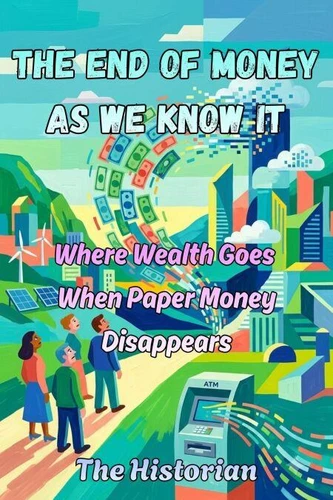
The End of Money as We Know It, explores how the global economy is shifting from a world centered on paper money to one driven by digital networks, programmable currencies, and new forms of value. Rather than focusing solely on cryptocurrencies or central bank digital currencies, the book argues that wealth itself is being redefined. The author identifies five emerging sources of economic power: energy, attention, trust and reputation, creation and context, and participation in networks and communities.
As cash becomes less important, individuals can build wealth by developing valuable skills, cultivating trusted reputations, earning and managing attention, creating unique human-centered work, and participating in digital ecosystems. The book also examines possible future monetary systems, the rise of decentralized technologies, and practical strategies for maintaining financial independence in a rapidly changing world.
Ultimately, it argues that future prosperity will depend less on how much money a person owns and more on their ability to generate value through multiple interconnected sources.
The End of Money as We Know It, explores how the global economy is shifting from a world centered on paper money to one driven by digital networks, programmable currencies, and new forms of value. Rather than focusing solely on cryptocurrencies or central bank digital currencies, the book argues that wealth itself is being redefined. The author identifies five emerging sources of economic power: energy, attention, trust and reputation, creation and context, and participation in networks and communities.
As cash becomes less important, individuals can build wealth by developing valuable skills, cultivating trusted reputations, earning and managing attention, creating unique human-centered work, and participating in digital ecosystems. The book also examines possible future monetary systems, the rise of decentralized technologies, and practical strategies for maintaining financial independence in a rapidly changing world.
Ultimately, it argues that future prosperity will depend less on how much money a person owns and more on their ability to generate value through multiple interconnected sources.

 , qui est-ce ?