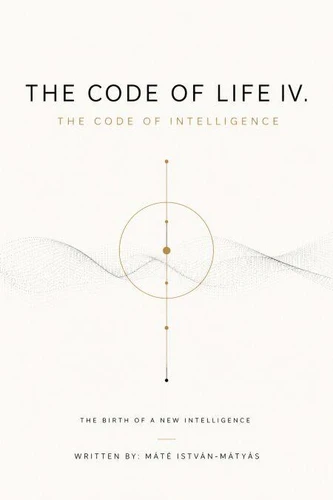
Máté István-Mátyás: The Code of Life IV. - The Code of IntelligenceWhat if we rebuilt artificial intelligence entirely from scratch? Today's artificial intelligence development is producing astonishing leaps, yet the global focus remains largely confined to bigger models, massive amounts of data, and brutal computing power. In this provocative and radical book-the fourth volume of The Code of Life series-Máté István-Mátyás points out that we might be asking the completely wrong question.
Raw intelligence alone is no guarantee of anything: a system can be fast and creative, but if its connection to reality is flawed, it can easily become a source of danger. By analyzing the inner workings of individuals, businesses, and humanity in his previous volumes, the author realized that the foundation of all stable systems relies on the exact same universal logic: the ability to perceive reality, recognize errors, remain humble, and function at the right rhythm.
From this core idea, the central question of the book is born: What would happen if an artificial intelligence were designed from the ground up according to the Code of Life?This work is not about a simple chatbot or just another mainstream AI model; it presents the theoretical blueprint of a completely new, adaptive architecture. Step by step, module by module, the author builds the pillars of the stable intelligence of the future-a system that doesn't just generate answers but is capable of deep self-correction.
Within the pages of the book, the six fundamental core modules of the proposed system come to life: Reality Connection Module: Continuously measures what is known, what is uncertain, and the gap between raw data and factual reality. Error Detection Module: The system's internal alarm, filtering out contradictions and potential hallucinations before any response is delivered. Correction Module: Instead of applying superficial fixes, this module updates the internal operational model to achieve true learning.
Adaptation Module: Ensures that the AI dynamically shifts its strategy based on context, the user, and the level of risk. Epistemic Humility Module: A shield against false absolute certainty; it grants the system the honest capability to say: "I don't know." Sense of Rhythm Module: The AI's internal braking and timing system, introducing a "maturation pause, " because the key to stability is not non-stop rushing, but the right rhythm.
The author does not stop at pure philosophy: in the final third of the book, he subjects this model to a ruthless reality check, demonstrating the practical levels of implementation (from layers built around current LLMs to native architectures) and analyzing potential dangers. The Code of Intelligence is essential reading for anyone fascinated by the future of technology, the direction AI is heading, or the deepest nature of both human and mechanical intelligence.
Because the true measure of intelligence is not how rarely it makes a mistake, but how quickly it can return to reality once it drifts away from it. Are you ready to redefine everything you thought you knew about smart machines?
Máté István-Mátyás: The Code of Life IV. - The Code of IntelligenceWhat if we rebuilt artificial intelligence entirely from scratch? Today's artificial intelligence development is producing astonishing leaps, yet the global focus remains largely confined to bigger models, massive amounts of data, and brutal computing power. In this provocative and radical book-the fourth volume of The Code of Life series-Máté István-Mátyás points out that we might be asking the completely wrong question.
Raw intelligence alone is no guarantee of anything: a system can be fast and creative, but if its connection to reality is flawed, it can easily become a source of danger. By analyzing the inner workings of individuals, businesses, and humanity in his previous volumes, the author realized that the foundation of all stable systems relies on the exact same universal logic: the ability to perceive reality, recognize errors, remain humble, and function at the right rhythm.
From this core idea, the central question of the book is born: What would happen if an artificial intelligence were designed from the ground up according to the Code of Life?This work is not about a simple chatbot or just another mainstream AI model; it presents the theoretical blueprint of a completely new, adaptive architecture. Step by step, module by module, the author builds the pillars of the stable intelligence of the future-a system that doesn't just generate answers but is capable of deep self-correction.
Within the pages of the book, the six fundamental core modules of the proposed system come to life: Reality Connection Module: Continuously measures what is known, what is uncertain, and the gap between raw data and factual reality. Error Detection Module: The system's internal alarm, filtering out contradictions and potential hallucinations before any response is delivered. Correction Module: Instead of applying superficial fixes, this module updates the internal operational model to achieve true learning.
Adaptation Module: Ensures that the AI dynamically shifts its strategy based on context, the user, and the level of risk. Epistemic Humility Module: A shield against false absolute certainty; it grants the system the honest capability to say: "I don't know." Sense of Rhythm Module: The AI's internal braking and timing system, introducing a "maturation pause, " because the key to stability is not non-stop rushing, but the right rhythm.
The author does not stop at pure philosophy: in the final third of the book, he subjects this model to a ruthless reality check, demonstrating the practical levels of implementation (from layers built around current LLMs to native architectures) and analyzing potential dangers. The Code of Intelligence is essential reading for anyone fascinated by the future of technology, the direction AI is heading, or the deepest nature of both human and mechanical intelligence.
Because the true measure of intelligence is not how rarely it makes a mistake, but how quickly it can return to reality once it drifts away from it. Are you ready to redefine everything you thought you knew about smart machines?

 , qui est-ce ?