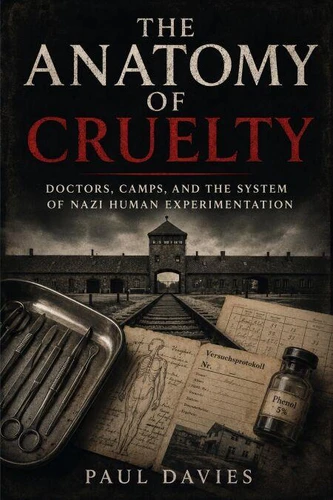
In the laboratories and barracks of the Third Reich, medicine became a weapon. The Anatomy of Cruelty reconstructs the system of Nazi human experimentation - a network of doctors, institutes, and camps that turned scientific ambition into organised destruction. Paul?Davies traces the evolution of the "Medical Reich, " from its ideological origins in racial hygiene to its transformation of concentration camps into laboratories of coercion.
Each chapter exposes a different facet of the machinery: freezing and hypothermia trials at Dachau, high-altitude decompression experiments, deliberate infection with typhus and malaria, surgical mutilations at Ravensbrück, sterilisation and poison tests, and the creation of the Jewish Skeleton Collection for anatomical study. The book follows the physicians who directed and performed these experiments - Karl?Brandt, Sigmund?Rascher, Josef?Mengele, Fritz?Fischer, Herta?Oberheuser, and dozens more - revealing how professional authority and bureaucratic obedience fused into a system of destruction.
Their careers form a chilling map of complicity: from the sterilisation courts of the 1930s to the killing blocks of Auschwitz and Dachau, from the Reich's medical institutes to the post-war trials and silences that followed. Paul Davies examines how the boundaries of life and death were erased in "terminal experiments, " how the pursuit of data justified murder, and how the collapse of the Medical Reich left behind both ruins and records - fragments of science built on suffering.
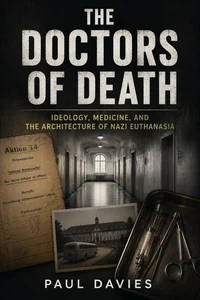
The final chapters confront the aftermath: the Doctors' Trial at Nuremberg, the rehabilitation of perpetrators, and the enduring silence that allowed many to resume their careers. Written with historical precision and cinematic clarity, The Anatomy of Cruelty is not only a study of Nazi medical crimes but a warning about the fragility of ethics when ideology and science converge. It stands as a companion to The Doctors of Death, completing a two-volume examination of medicine's darkest hour.
In the laboratories and barracks of the Third Reich, medicine became a weapon. The Anatomy of Cruelty reconstructs the system of Nazi human experimentation - a network of doctors, institutes, and camps that turned scientific ambition into organised destruction. Paul?Davies traces the evolution of the "Medical Reich, " from its ideological origins in racial hygiene to its transformation of concentration camps into laboratories of coercion.
Each chapter exposes a different facet of the machinery: freezing and hypothermia trials at Dachau, high-altitude decompression experiments, deliberate infection with typhus and malaria, surgical mutilations at Ravensbrück, sterilisation and poison tests, and the creation of the Jewish Skeleton Collection for anatomical study. The book follows the physicians who directed and performed these experiments - Karl?Brandt, Sigmund?Rascher, Josef?Mengele, Fritz?Fischer, Herta?Oberheuser, and dozens more - revealing how professional authority and bureaucratic obedience fused into a system of destruction.
Their careers form a chilling map of complicity: from the sterilisation courts of the 1930s to the killing blocks of Auschwitz and Dachau, from the Reich's medical institutes to the post-war trials and silences that followed. Paul Davies examines how the boundaries of life and death were erased in "terminal experiments, " how the pursuit of data justified murder, and how the collapse of the Medical Reich left behind both ruins and records - fragments of science built on suffering.
The final chapters confront the aftermath: the Doctors' Trial at Nuremberg, the rehabilitation of perpetrators, and the enduring silence that allowed many to resume their careers. Written with historical precision and cinematic clarity, The Anatomy of Cruelty is not only a study of Nazi medical crimes but a warning about the fragility of ethics when ideology and science converge. It stands as a companion to The Doctors of Death, completing a two-volume examination of medicine's darkest hour.

 , qui est-ce ?