They were the men who governed the Reich from within - the Gauleiters - Hitler's regional commanders who transformed ideology into administration and turned provincial offices into engines of control. In every city, every district, every borderland, a Gauleiter stood as the regime's local embodiment: part politician, part overseer, part enforcer. Their power was intimate, immediate, and often devastating.
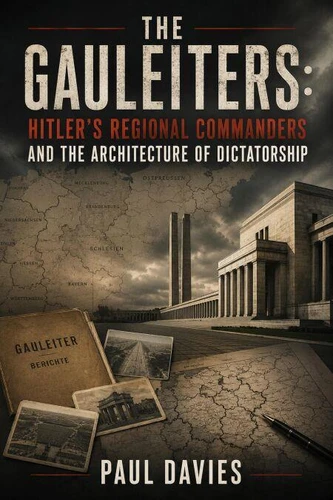
In The Gauleiters, Paul Davies reconstructs the rise, rule, and collapse of these provincial leaders with cinematic clarity and archival precision. Drawing on extensive research, he reveals how the Nazi dictatorship was not sustained solely by Berlin's central command but by a network of regional authorities who shaped daily life, enforced policy, and carried out the regime's most destructive ambitions.
Across these pages, readers encounter men whose careers illuminate the inner workings of the Third Reich: administrators who believed they were safeguarding their regions, ideologues who saw themselves as guardians of a new political order, and opportunists who rode the wave of dictatorship until it broke beneath them. Their stories trace the evolution of Nazi power from its early Austrian and German roots through the war years and into the chaotic final days when authority dissolved and survival became their only objective.
Each chapter offers a distinct emotional and historical texture - from the bureaucratic routines that masked brutality to the frantic improvisations of a collapsing state. Davies shows how the Gauleiters' decisions shaped the fate of millions, how their loyalties hardened into dogma, and how their authority evaporated once the machinery of dictatorship fell apart. The Gauleiters is both a collective biography and a structural study of power: a portrait of the men who made the Reich function at ground level, and a forensic examination of how dictatorship embeds itself through regional governance.
It is a book for readers seeking to understand not only who these men were, but how the architecture of Nazi rule operated from the inside. Meticulously researched and written with documentary intensity, this volume offers a definitive exploration of the Third Reich's provincial commanders - the forgotten architects of a system built on obedience, ideology, and administrative violence.
They were the men who governed the Reich from within - the Gauleiters - Hitler's regional commanders who transformed ideology into administration and turned provincial offices into engines of control. In every city, every district, every borderland, a Gauleiter stood as the regime's local embodiment: part politician, part overseer, part enforcer. Their power was intimate, immediate, and often devastating.
In The Gauleiters, Paul Davies reconstructs the rise, rule, and collapse of these provincial leaders with cinematic clarity and archival precision. Drawing on extensive research, he reveals how the Nazi dictatorship was not sustained solely by Berlin's central command but by a network of regional authorities who shaped daily life, enforced policy, and carried out the regime's most destructive ambitions.
Across these pages, readers encounter men whose careers illuminate the inner workings of the Third Reich: administrators who believed they were safeguarding their regions, ideologues who saw themselves as guardians of a new political order, and opportunists who rode the wave of dictatorship until it broke beneath them. Their stories trace the evolution of Nazi power from its early Austrian and German roots through the war years and into the chaotic final days when authority dissolved and survival became their only objective.
Each chapter offers a distinct emotional and historical texture - from the bureaucratic routines that masked brutality to the frantic improvisations of a collapsing state. Davies shows how the Gauleiters' decisions shaped the fate of millions, how their loyalties hardened into dogma, and how their authority evaporated once the machinery of dictatorship fell apart. The Gauleiters is both a collective biography and a structural study of power: a portrait of the men who made the Reich function at ground level, and a forensic examination of how dictatorship embeds itself through regional governance.
It is a book for readers seeking to understand not only who these men were, but how the architecture of Nazi rule operated from the inside. Meticulously researched and written with documentary intensity, this volume offers a definitive exploration of the Third Reich's provincial commanders - the forgotten architects of a system built on obedience, ideology, and administrative violence.

 , qui est-ce ?