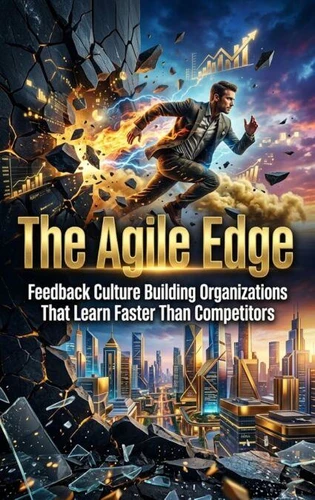
The Agile Edge. Feedback Culture Building Organizations That Learn Faster Than Competitors
Par :Formats :
Disponible dans votre compte client Decitre ou Furet du Nord dès validation de votre commande. Le format ePub est :
- Compatible avec une lecture sur My Vivlio (smartphone, tablette, ordinateur)
- Compatible avec une lecture sur liseuses Vivlio
- Pour les liseuses autres que Vivlio, vous devez utiliser le logiciel Adobe Digital Edition. Non compatible avec la lecture sur les liseuses Kindle, Remarkable et Sony
 , qui est-ce ?
Notre partenaire de plateforme de lecture numérique où vous retrouverez l'ensemble de vos ebooks gratuitement
Pour en savoir plus sur nos ebooks, consultez notre aide en ligne ici
C'est si simple ! Lisez votre ebook avec l'app Vivlio sur votre tablette, mobile ou ordinateur :

- Nombre de pages137
- FormatePub
- ISBN978-3-565-45499-0
- EAN9783565454990
- Date de parution23/05/2026
- Protection num.pas de protection
- Taille2 Mo
- Infos supplémentairesepub
- ÉditeurEmphaloz Publishing House
Résumé
This book examines how agility creates competitive advantage through feedback cultures that accelerate organizational learning, not as a leadership tactic but as a systemic mechanism where timely insights fuel real time adaptation and sustained performance in German and European markets. It explores how continuous feedback transforms organizations into more responsive, resilient, and innovation driven systems.
The first mechanism centers on real time feedback loops that replace infrequent performance reviews with continuous exchange.
Frequent, focused, and future oriented feedback allows employees to adjust quickly, turning insights into immediate action and reducing the delay between learning and improvement. This creates a competitive edge by enabling organizations to respond faster to changing conditions. Second, the manager as coach system reshapes leadership architecture. Instead of acting primarily as evaluators, leaders become growth catalysts who guide development through ongoing conversations, active listening, and solution oriented dialogue.
This approach strengthens engagement while creating an environment where performance calibration and recognition occur continuously rather than episodically. Third, two way feedback dialogue establishes psychological safety as a core organizational condition. When peer to peer and cross functional exchanges are normalized, trust deepens and collaboration strengthens. Learning and innovation emerge naturally from cultures where candid communication is expected and avoidance is discouraged.
Feedback therefore becomes not only a performance tool but also a mechanism for collective adaptation and organizational resilience.
Frequent, focused, and future oriented feedback allows employees to adjust quickly, turning insights into immediate action and reducing the delay between learning and improvement. This creates a competitive edge by enabling organizations to respond faster to changing conditions. Second, the manager as coach system reshapes leadership architecture. Instead of acting primarily as evaluators, leaders become growth catalysts who guide development through ongoing conversations, active listening, and solution oriented dialogue.
This approach strengthens engagement while creating an environment where performance calibration and recognition occur continuously rather than episodically. Third, two way feedback dialogue establishes psychological safety as a core organizational condition. When peer to peer and cross functional exchanges are normalized, trust deepens and collaboration strengthens. Learning and innovation emerge naturally from cultures where candid communication is expected and avoidance is discouraged.
Feedback therefore becomes not only a performance tool but also a mechanism for collective adaptation and organizational resilience.