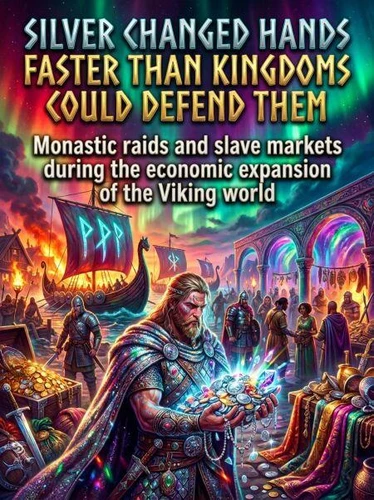
Silver Changed Hands Faster Than Kingdoms Could Defend Them. Monastic raids and slave markets during the economic expansion of the Viking world
Par :Formats :
Disponible dans votre compte client Decitre ou Furet du Nord dès validation de votre commande. Le format ePub est :
- Compatible avec une lecture sur My Vivlio (smartphone, tablette, ordinateur)
- Compatible avec une lecture sur liseuses Vivlio
- Pour les liseuses autres que Vivlio, vous devez utiliser le logiciel Adobe Digital Edition. Non compatible avec la lecture sur les liseuses Kindle, Remarkable et Sony
 , qui est-ce ?
Notre partenaire de plateforme de lecture numérique où vous retrouverez l'ensemble de vos ebooks gratuitement
Pour en savoir plus sur nos ebooks, consultez notre aide en ligne ici
C'est si simple ! Lisez votre ebook avec l'app Vivlio sur votre tablette, mobile ou ordinateur :

- Nombre de pages172
- FormatePub
- ISBN978-3-565-47872-9
- EAN9783565478729
- Date de parution05/06/2026
- Protection num.pas de protection
- Taille1 Mo
- Infos supplémentairesepub
- ÉditeurEmphaloz Publishing House
Résumé
Viking raids were driven by more than violence alone. Behind attacks on monasteries and coastal settlements stood economic systems shaped by clan competition, trade ambition, and access to one of medieval Europe's most profitable commodities: human labor.
This account explores the social and economic foundations of Viking expansion. Scandinavian elites strengthened status and political influence through wealth acquired in raiding expeditions, tribute extraction, and international trade.
Captives taken during attacks entered slave networks extending from the British Isles to the Islamic world and eastern Europe. The book also examines how decentralized clan structures encouraged overseas ventures. Younger warriors sought land, silver, and social advancement unavailable within limited Scandinavian agricultural systems. Economic opportunity and political fragmentation together sustained repeated waves of maritime aggression and commercial exchange. The Viking world emerges here as a dynamic economy of mobility where warfare, trade, and slavery formed interconnected parts of a rapidly expanding northern network.
Captives taken during attacks entered slave networks extending from the British Isles to the Islamic world and eastern Europe. The book also examines how decentralized clan structures encouraged overseas ventures. Younger warriors sought land, silver, and social advancement unavailable within limited Scandinavian agricultural systems. Economic opportunity and political fragmentation together sustained repeated waves of maritime aggression and commercial exchange. The Viking world emerges here as a dynamic economy of mobility where warfare, trade, and slavery formed interconnected parts of a rapidly expanding northern network.