
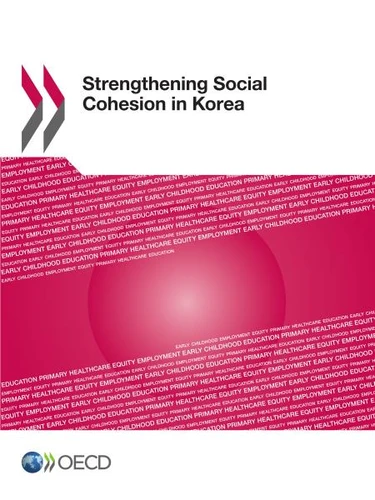
Strengthening social cohesion in korea
Par :Formats :
Disponible dans votre compte client Decitre ou Furet du Nord dès validation de votre commande. Le format PDF est :
- Compatible avec une lecture sur My Vivlio (smartphone, tablette, ordinateur)
- Compatible avec une lecture sur liseuses Vivlio
- Pour les liseuses autres que Vivlio, vous devez utiliser le logiciel Adobe Digital Edition. Non compatible avec la lecture sur les liseuses Kindle, Remarkable et Sony
 , qui est-ce ?
Notre partenaire de plateforme de lecture numérique où vous retrouverez l'ensemble de vos ebooks gratuitement
Pour en savoir plus sur nos ebooks, consultez notre aide en ligne ici
C'est si simple ! Lisez votre ebook avec l'app Vivlio sur votre tablette, mobile ou ordinateur :

- Nombre de pages248
- FormatPDF
- ISBN978-92-64-18894-5
- EAN9789264188945
- Date de parution14/03/2013
- Protection num.Digital Watermarking
- Taille5 Mo
- Infos supplémentairespdf
- ÉditeurOECD
Résumé
Korea is confronting a serious challenges. It has to improve income equality in the context of a severe demographic transition. Such a transition, from one of the youngest populations in the OECD at present to the second oldest by 2050, may boost the need for public spending and slow economic growth. In this context and as the pace of population ageing is accelerating, it is important to act quickly in a wide range of areas:-Policies to sustain Korea's growth potential in the face of falling labour inputs;-Measures that improve both growth and equality;-Carefully-targeted increases in social spending to reduce inequality and poverty;-Financing higher social spending, with priority given to a reform of tax and social security that minimises the negative impact on output growth.
Against the background of these broad challenges, which are discussed in a specific, setting-the-ground, Chapter, the report suggests policy options, based on the practices and reforms of other countries, in the following four areas: I) Income Distribution and Poverty; II) Tackling the Duality of the Labour Market; III) Early Childcare; and IV) Moving beyond Hospitals to better Care in the Community.
Against the background of these broad challenges, which are discussed in a specific, setting-the-ground, Chapter, the report suggests policy options, based on the practices and reforms of other countries, in the following four areas: I) Income Distribution and Poverty; II) Tackling the Duality of the Labour Market; III) Early Childcare; and IV) Moving beyond Hospitals to better Care in the Community.
A propos de OCDE


32,99 €

72,99 €

33,99 €

32,99 €
32,99 €

32,00 €

Tax compilance by design
E-book
16,00 €

16,00 €

19,00 €

16,00 €

25,00 €


23,00 €

Women in business 2014
E-book
31,00 €


27,00 €