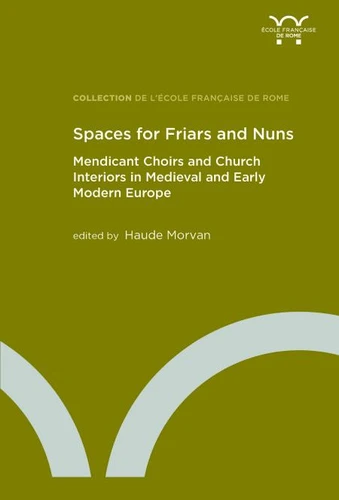
Spaces for friars and nuns. Mendicant choirs and church interiors in medieval and early modern Europe
Par :Formats :
Disponible dans votre compte client Decitre ou Furet du Nord dès validation de votre commande. Le format Multi-format est :
- Pour les liseuses autres que Vivlio, vous devez utiliser le logiciel Adobe Digital Edition. Non compatible avec la lecture sur les liseuses Kindle, Remarkable et Sony
 , qui est-ce ?
Notre partenaire de plateforme de lecture numérique où vous retrouverez l'ensemble de vos ebooks gratuitement
Pour en savoir plus sur nos ebooks, consultez notre aide en ligne ici
C'est si simple ! Lisez votre ebook avec l'app Vivlio sur votre tablette, mobile ou ordinateur :

- Nombre de pages392
- FormatMulti-format
- ISBN978-2-7283-1534-5
- EAN9782728315345
- Date de parution19/07/2022
- Protection num.pas de protection
- Infos supplémentairesMulti-Format
- ÉditeurPublications de l’École français...
Résumé
In the thirteenth century, mendicant orders introduced new ways of religious life that engaged the laity through preaching and conversion. Moreover, they founded new movements for religious women dedicated to prayer and contemplation, such as the Dominican nuns and the Poor Clares. In their churches, both friars and nuns were separated from the laity, either in choir precincts situated behind architectural screens, or in upper galleries raised above ground level.
Before the widespread removal of these furnishings, therefore, medieval and early modern mendicant church interiors did not resemble the unified spaces we encounter today. This volume presents a series of European case studies which use textual and material evidence to reconstruct and analyze the internal divisions of churches between the thirteenth and the sixteenth century. Thus, the authors provide a broad understanding of the variety, function, and meaning of the internal divisions that once conditioned the spiritual experience, function and meaning of sacred space for the laity as well as for the religious community.
Before the widespread removal of these furnishings, therefore, medieval and early modern mendicant church interiors did not resemble the unified spaces we encounter today. This volume presents a series of European case studies which use textual and material evidence to reconstruct and analyze the internal divisions of churches between the thirteenth and the sixteenth century. Thus, the authors provide a broad understanding of the variety, function, and meaning of the internal divisions that once conditioned the spiritual experience, function and meaning of sacred space for the laity as well as for the religious community.