SOLDES
Jusqu'à -70% sur une sélection d'articles*

Nouveauté
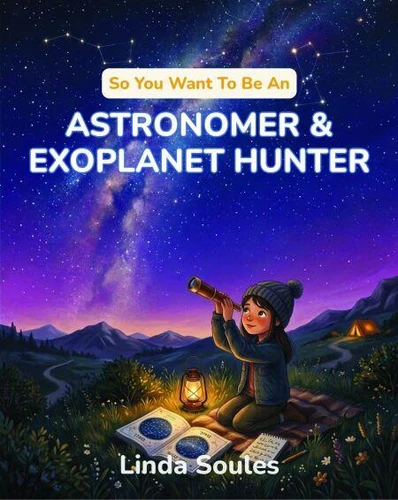
So You Want To Be An Astronomer & Exoplanet Hunter. So You Want To Be A..., #30
Par :Formats :
Disponible dans votre compte client Decitre ou Furet du Nord dès validation de votre commande. Le format ePub est :
- Compatible avec une lecture sur My Vivlio (smartphone, tablette, ordinateur)
- Compatible avec une lecture sur liseuses Vivlio
- Pour les liseuses autres que Vivlio, vous devez utiliser le logiciel Adobe Digital Edition. Non compatible avec la lecture sur les liseuses Kindle, Remarkable et Sony
 , qui est-ce ?
Notre partenaire de plateforme de lecture numérique où vous retrouverez l'ensemble de vos ebooks gratuitement
Pour en savoir plus sur nos ebooks, consultez notre aide en ligne ici
C'est si simple ! Lisez votre ebook avec l'app Vivlio sur votre tablette, mobile ou ordinateur :

- FormatePub
- ISBN8235127616
- EAN9798235127616
- Date de parution30/05/2026
- Protection num.pas de protection
- Infos supplémentairesepub
- ÉditeurIoakim Ioakim
Résumé
Somewhere right now, a space telescope is staring at a single patch of sky and tracking thousands of stars at once - watching for a flicker of dimming light so faint that one part in ten thousand counts as a signal. That flicker might be noise. Or it might be the shadow of a world no human has ever seen, crossing in front of its star hundreds of light-years away. Welcome to the real work of exoplanet hunting - one of the most exciting frontiers in space science.
So You Want To Be An Astronomer and Exoplanet Hunter takes curious young readers ages 10 to 14 inside this extraordinary profession, not the Hollywood version but the real one. The years of physics, math, and patience that come before an astronomer ever points a telescope at the night sky. The painstaking art of finding new planets by measuring changes in starlight so small the human eye could never detect them.
The long observation runs planned years in advance to gather photons that left their stars before humans existed. This is a career guide built on honesty and genuine wonder. Inside, you will explore how the transit method catches a planet's shadow crossing a distant star, how spectroscopy reads the chemical fingerprints of alien atmospheres, and how radial velocity captures the faint stellar wobble that gave away the very first exoplanet.
You will learn about the space telescopes scanning entire sections of the sky and the mountaintop observatories perched above the clouds where astronomers work through the night collecting data on stars, planets, and galaxies far beyond our solar system. But this book does more than explain the science. It profiles the legendary astronomers who opened the universe to human understanding - including women who broke through institutional barriers to make discoveries that changed everything we know about dark matter, comets, and distant worlds.
Three of the five featured scientists are women whose persistence reshaped the field. The most surprising fact in these pages may be this: you do not need a degree to start hunting for exoplanets. Real telescope data is publicly available, and citizen science platforms have already helped ordinary people without astronomy training confirm the existence of real planets orbiting distant stars. The book lays out practical steps you can take right now: learn the constellations, try a small telescope to spot Saturn's rings or Jupiter's moons, explore real datasets online, and start building the math and coding skills that professional astronomers depend on every day.
A detailed day-in-the-life section walks you through a real observing night from dome opening at sunset through calibration, a twelve-target run, weather interruptions, and the morning data analysis that follows. Fun facts scattered throughout reveal the astonishing strangeness of known exoplanets - worlds where it rains molten iron, where glass flies sideways in screaming winds, and where double sunsets light up alien skies.
Written in a warm, direct voice that trusts young readers with real science and real vocabulary, this book does not talk down to kids - it brings them all the way in. It blends stargazing inspiration with a space science deep dive, and an honest look at what it takes to turn curiosity about the night sky into a life spent exploring the universe. For the young person who looks up and does not just feel the wonder but immediately wants to know what is out there - and whether we might finally answer the biggest question in astronomy: are we alone?Ages 10 to 14.
Illustrated nonfiction. Science and nature.
So You Want To Be An Astronomer and Exoplanet Hunter takes curious young readers ages 10 to 14 inside this extraordinary profession, not the Hollywood version but the real one. The years of physics, math, and patience that come before an astronomer ever points a telescope at the night sky. The painstaking art of finding new planets by measuring changes in starlight so small the human eye could never detect them.
The long observation runs planned years in advance to gather photons that left their stars before humans existed. This is a career guide built on honesty and genuine wonder. Inside, you will explore how the transit method catches a planet's shadow crossing a distant star, how spectroscopy reads the chemical fingerprints of alien atmospheres, and how radial velocity captures the faint stellar wobble that gave away the very first exoplanet.
You will learn about the space telescopes scanning entire sections of the sky and the mountaintop observatories perched above the clouds where astronomers work through the night collecting data on stars, planets, and galaxies far beyond our solar system. But this book does more than explain the science. It profiles the legendary astronomers who opened the universe to human understanding - including women who broke through institutional barriers to make discoveries that changed everything we know about dark matter, comets, and distant worlds.
Three of the five featured scientists are women whose persistence reshaped the field. The most surprising fact in these pages may be this: you do not need a degree to start hunting for exoplanets. Real telescope data is publicly available, and citizen science platforms have already helped ordinary people without astronomy training confirm the existence of real planets orbiting distant stars. The book lays out practical steps you can take right now: learn the constellations, try a small telescope to spot Saturn's rings or Jupiter's moons, explore real datasets online, and start building the math and coding skills that professional astronomers depend on every day.
A detailed day-in-the-life section walks you through a real observing night from dome opening at sunset through calibration, a twelve-target run, weather interruptions, and the morning data analysis that follows. Fun facts scattered throughout reveal the astonishing strangeness of known exoplanets - worlds where it rains molten iron, where glass flies sideways in screaming winds, and where double sunsets light up alien skies.
Written in a warm, direct voice that trusts young readers with real science and real vocabulary, this book does not talk down to kids - it brings them all the way in. It blends stargazing inspiration with a space science deep dive, and an honest look at what it takes to turn curiosity about the night sky into a life spent exploring the universe. For the young person who looks up and does not just feel the wonder but immediately wants to know what is out there - and whether we might finally answer the biggest question in astronomy: are we alone?Ages 10 to 14.
Illustrated nonfiction. Science and nature.