A former corporate burnout who rebuilt her life through mindfulness routines, now blending self-help for stress mastery, business coaching on team wellness, and historical analysis of wellness movements in industrial eras.
Nouveauté
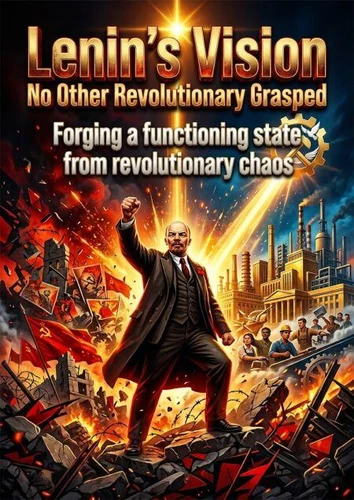
Lenin's Vision No Other Revolutionary Grasped. Forging a functioning state from revolutionary chaos
Par :Formats :
Disponible dans votre compte client Decitre ou Furet du Nord dès validation de votre commande. Le format ePub est :
- Compatible avec une lecture sur My Vivlio (smartphone, tablette, ordinateur)
- Compatible avec une lecture sur liseuses Vivlio
- Pour les liseuses autres que Vivlio, vous devez utiliser le logiciel Adobe Digital Edition. Non compatible avec la lecture sur les liseuses Kindle, Remarkable et Sony
 , qui est-ce ?
Notre partenaire de plateforme de lecture numérique où vous retrouverez l'ensemble de vos ebooks gratuitement
Pour en savoir plus sur nos ebooks, consultez notre aide en ligne ici
C'est si simple ! Lisez votre ebook avec l'app Vivlio sur votre tablette, mobile ou ordinateur :

- Nombre de pages223
- FormatePub
- ISBN978-3-565-59509-9
- EAN9783565595099
- Date de parution28/07/2026
- Protection num.pas de protection
- Taille1 Mo
- Infos supplémentairesepub
- ÉditeurEmphaloz Publishing House
Résumé
Lenin arrived at the Finland Station in April 1917 with a theory that seemed impossible: that a disciplined party could seize not just power but the very machinery of history. This book examines how the Bolsheviks transformed a fractured revolutionary moment into a durable authoritarian state, focusing on the organizational logic that set them apart from every other faction. It traces the key decisions-the April Theses, the decision to boycott the Provisional Government, the strategic timing of the October insurrection-and shows how each step built institutional capacity from chaos.
Rather than a biography of Lenin or a narrative of battles, this work analyzes the revolution as a problem of organization: how a small, determined group can concentrate power when traditional structures collapse. It explores the relationship between Marxist theory and practical governance, from the dissolution of the Constituent Assembly to the creation of the Cheka. The book offers a clear framework for understanding how revolutionary ideas become governing realities, and why some revolutions succeed while others fragment.
Rather than a biography of Lenin or a narrative of battles, this work analyzes the revolution as a problem of organization: how a small, determined group can concentrate power when traditional structures collapse. It explores the relationship between Marxist theory and practical governance, from the dissolution of the Constituent Assembly to the creation of the Cheka. The book offers a clear framework for understanding how revolutionary ideas become governing realities, and why some revolutions succeed while others fragment.
A propos de Veda Grant



24,99 €







9,99 €