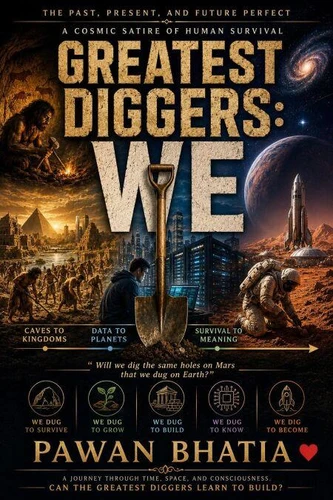
Greatest Diggers: WE by Pawan Bhatia is a cosmic satire tracing humanity's defining behavior-digging-across two million years. From prehistoric wells and Neolithic agriculture to modern data extraction and proposed Martian ice drills, Bhatia argues that our fundamental survival instincts remain unchanged even as technology evolves. The book is structured in four parts: Past Survival examines ancient caves, fire, burial rites, and early mines, revealing that extraction was always paired with reverence.
Present Survival critiques the digital attention economy, energy geopolitics, and the climate crisis, showing how we now mine data and fossil fuels with the same reckless abandon as our ancestors mined copper and gold. Future Survival explores off-world expansion-Martian shelters, lunar mining, asteroid extraction-questioning whether space represents genuine escape or merely a larger canvas for old patterns.
The final section, The Cosmic Question, presents both optimist and pessimist cases: can we build cooperative institutions and circular economies, or will we replicate colonialism and resource wars among the stars?Bhatia deliberately refuses a tidy resolution, emphasizing that the pattern of digging is neither purely noble nor purely destructive-it is simply real. He introduces recurring devices like "Field Notes" on research methodology and "cosmic satire" passages that view human folly from an imagined alien perspective, creating distance for honest reflection.
The book draws on diverse sources-archaeology, climate science, space law, and philosophy-to argue that while we are capable of learning (evidenced by the Montreal Protocol and cooperative commons governance), we are equally prone to repeating mistakes (carbon emissions continue rising despite decades of warnings). Ultimately, the author leaves the shovel in the reader's hands, asking: what will you choose to dig for? The answer is not predetermined; it depends on conscious choices about whether to carry extraction habits into the cosmos or finally learn to build sustainably.
This is a sober, humorous, and deeply humanist inquiry into our oldest behavior and its uncertain future.
Greatest Diggers: WE by Pawan Bhatia is a cosmic satire tracing humanity's defining behavior-digging-across two million years. From prehistoric wells and Neolithic agriculture to modern data extraction and proposed Martian ice drills, Bhatia argues that our fundamental survival instincts remain unchanged even as technology evolves. The book is structured in four parts: Past Survival examines ancient caves, fire, burial rites, and early mines, revealing that extraction was always paired with reverence.
Present Survival critiques the digital attention economy, energy geopolitics, and the climate crisis, showing how we now mine data and fossil fuels with the same reckless abandon as our ancestors mined copper and gold. Future Survival explores off-world expansion-Martian shelters, lunar mining, asteroid extraction-questioning whether space represents genuine escape or merely a larger canvas for old patterns.
The final section, The Cosmic Question, presents both optimist and pessimist cases: can we build cooperative institutions and circular economies, or will we replicate colonialism and resource wars among the stars?Bhatia deliberately refuses a tidy resolution, emphasizing that the pattern of digging is neither purely noble nor purely destructive-it is simply real. He introduces recurring devices like "Field Notes" on research methodology and "cosmic satire" passages that view human folly from an imagined alien perspective, creating distance for honest reflection.
The book draws on diverse sources-archaeology, climate science, space law, and philosophy-to argue that while we are capable of learning (evidenced by the Montreal Protocol and cooperative commons governance), we are equally prone to repeating mistakes (carbon emissions continue rising despite decades of warnings). Ultimately, the author leaves the shovel in the reader's hands, asking: what will you choose to dig for? The answer is not predetermined; it depends on conscious choices about whether to carry extraction habits into the cosmos or finally learn to build sustainably.
This is a sober, humorous, and deeply humanist inquiry into our oldest behavior and its uncertain future.


 , qui est-ce ?