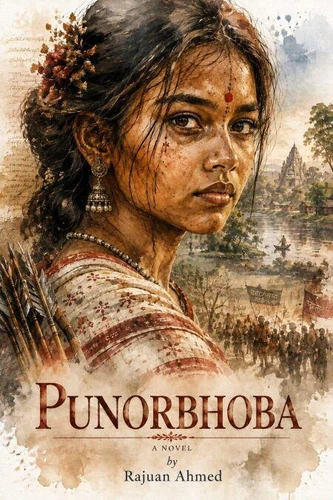
Rajuan Ahmed's novel Punorbhoba sits at the critical intersection of Indigenous Santal identity, subaltern history, and the 1971 Bangladesh Liberation War. Set along the banks of the Punorbhoba River near Dinajpur's ancient Kantanagar Temple, the story weaves the everyday realities of marginalized ethnic communities directly into Bangladesh's broader struggle for independence. Through the lives of Bohamoni Murmu, a Santal archer, and Nayan Chowdhury, an urban Bengali freedom fighter, the narrative highlights the vital yet often overlooked contributions of Adivasi populations during the 1971 conflict.
The story reaches its climax in a pair of devastating tragedies: the wartime destruction of the Santal hamlet of Majhipara and the historically documented disaster at Maharaja Girijanath High School in Dinajpur town on January 6, 1972. There, just weeks after the national victory, an accidental mine explosion killed over six hundred freedom fighters. At its core, the narrative draws on a deep sense of historical continuity.
Monohar Murmu, the village elder (Manjhi Haram), carries the living legacy of both the 1855 Santal Rebellion (Hul) and the 1946-1947 Tebhaga Movement of North Bengal. Bohamoni's guerrilla resistance serves as a direct physical continuation of this rebellious heritage. Throughout, Ahmed grounds the novel in authentic Santal ethno-cultural tradition, paying careful attention to attire such as the cotton Panchi Parhat saree, reverence for the supreme deity Marang Buru, and seasonal festivals like Sohrai and Baha.
And Baha.
Rajuan Ahmed's novel Punorbhoba sits at the critical intersection of Indigenous Santal identity, subaltern history, and the 1971 Bangladesh Liberation War. Set along the banks of the Punorbhoba River near Dinajpur's ancient Kantanagar Temple, the story weaves the everyday realities of marginalized ethnic communities directly into Bangladesh's broader struggle for independence. Through the lives of Bohamoni Murmu, a Santal archer, and Nayan Chowdhury, an urban Bengali freedom fighter, the narrative highlights the vital yet often overlooked contributions of Adivasi populations during the 1971 conflict.
The story reaches its climax in a pair of devastating tragedies: the wartime destruction of the Santal hamlet of Majhipara and the historically documented disaster at Maharaja Girijanath High School in Dinajpur town on January 6, 1972. There, just weeks after the national victory, an accidental mine explosion killed over six hundred freedom fighters. At its core, the narrative draws on a deep sense of historical continuity.
Monohar Murmu, the village elder (Manjhi Haram), carries the living legacy of both the 1855 Santal Rebellion (Hul) and the 1946-1947 Tebhaga Movement of North Bengal. Bohamoni's guerrilla resistance serves as a direct physical continuation of this rebellious heritage. Throughout, Ahmed grounds the novel in authentic Santal ethno-cultural tradition, paying careful attention to attire such as the cotton Panchi Parhat saree, reverence for the supreme deity Marang Buru, and seasonal festivals like Sohrai and Baha.
And Baha.

 , qui est-ce ?