Fiona Mitchell is an English-language nonfiction author recognized for her insightful books on human behavior, emotional wellbeing, and the psychology of modern living. Her writing combines careful research with a calm, conversational tone, helping readers explore complex emotional patterns with clarity and nuance rather than simplistic self-help formulas. Fiona often focuses on resilience, relationships, and the quiet internal shifts that shape personal growth over time.
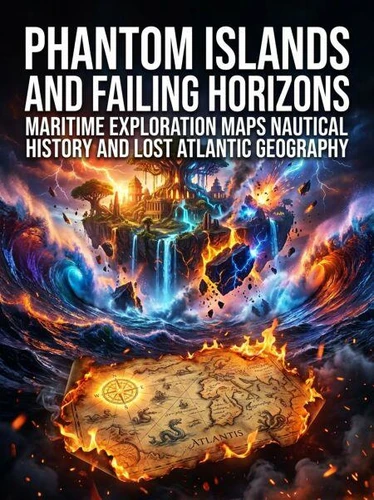
Phantom Islands and Failing Horizons. Maritime Exploration Maps Nautical History and Lost Atlantic Geography
Par :Formats :
Disponible dans votre compte client Decitre ou Furet du Nord dès validation de votre commande. Le format ePub est :
- Compatible avec une lecture sur My Vivlio (smartphone, tablette, ordinateur)
- Compatible avec une lecture sur liseuses Vivlio
- Pour les liseuses autres que Vivlio, vous devez utiliser le logiciel Adobe Digital Edition. Non compatible avec la lecture sur les liseuses Kindle, Remarkable et Sony
 , qui est-ce ?
Notre partenaire de plateforme de lecture numérique où vous retrouverez l'ensemble de vos ebooks gratuitement
Pour en savoir plus sur nos ebooks, consultez notre aide en ligne ici
C'est si simple ! Lisez votre ebook avec l'app Vivlio sur votre tablette, mobile ou ordinateur :

- Nombre de pages224
- FormatePub
- ISBN978-3-565-46503-3
- EAN9783565465033
- Date de parution28/05/2026
- Protection num.pas de protection
- Taille1 Mo
- Infos supplémentairesepub
- ÉditeurEmphaloz Publishing House
Résumé
A coastline seen at dusk could alter world maps for centuries. In maritime exploration, entire islands emerged from fear, distance, fog, and ambition, entering official navigation charts long before anyone proved they existed. Phantom islands shaped trade routes, naval expeditions, and imperial claims across the Atlantic and Pacific worlds.
Cartographers of the Age of Discovery relied on fragmented reports from exhausted sailors navigating uncertain seas.
A volcanic cloud became a continent. A mirage became territory. In nautical history, islands such as Hy-Brasil, Sandy Island, and Frisland survived on European maps because institutions trusted repetition more than verification. Royal navies copied earlier atlases, merchants financed voyages toward invisible land, and governments used uncertain geography to reinforce maritime influence. As global empires expanded, cartographic error became embedded within political authority itself. Using historical sea charts, captain journals, and satellite-era maritime records, this work traces how mistaken observations persisted through centuries of mapmaking.
The book follows the transition from hand-drawn navigation systems to modern geospatial science, revealing how technological limits shaped collective belief. Beneath every false island stood a deeper question about certainty, empire, and the human need to complete unknown spaces. The disappearance of phantom islands marked more than scientific correction. It closed a long European chapter in which imagination and geography could no longer be separated at sea.
A volcanic cloud became a continent. A mirage became territory. In nautical history, islands such as Hy-Brasil, Sandy Island, and Frisland survived on European maps because institutions trusted repetition more than verification. Royal navies copied earlier atlases, merchants financed voyages toward invisible land, and governments used uncertain geography to reinforce maritime influence. As global empires expanded, cartographic error became embedded within political authority itself. Using historical sea charts, captain journals, and satellite-era maritime records, this work traces how mistaken observations persisted through centuries of mapmaking.
The book follows the transition from hand-drawn navigation systems to modern geospatial science, revealing how technological limits shaped collective belief. Beneath every false island stood a deeper question about certainty, empire, and the human need to complete unknown spaces. The disappearance of phantom islands marked more than scientific correction. It closed a long European chapter in which imagination and geography could no longer be separated at sea.