Jörg Rüpke ist Professor für Vergleichende Religionswissenschaft an der Universität Erfurt. Er beschäftigt sich in seinen Arbeiten vornehmlich mit antiker Religionsgeschichte.
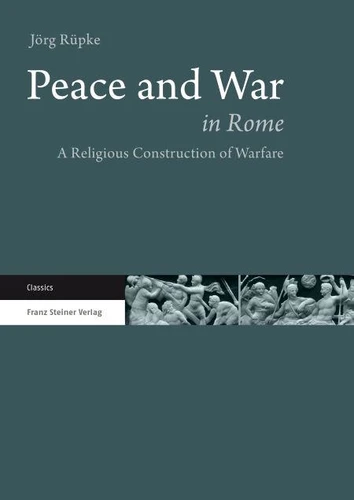
Peace and War in Rome. A Religious Construction of Warfare
Par : ,Formats :
Disponible dans votre compte client Decitre ou Furet du Nord dès validation de votre commande. Le format PDF est :
- Compatible avec une lecture sur My Vivlio (smartphone, tablette, ordinateur)
- Compatible avec une lecture sur liseuses Vivlio
- Pour les liseuses autres que Vivlio, vous devez utiliser le logiciel Adobe Digital Edition. Non compatible avec la lecture sur les liseuses Kindle, Remarkable et Sony
 , qui est-ce ?
Notre partenaire de plateforme de lecture numérique où vous retrouverez l'ensemble de vos ebooks gratuitement
Pour en savoir plus sur nos ebooks, consultez notre aide en ligne ici
C'est si simple ! Lisez votre ebook avec l'app Vivlio sur votre tablette, mobile ou ordinateur :

- Nombre de pages361
- FormatPDF
- ISBN978-3-515-12381-5
- EAN9783515123815
- Date de parution04/10/2019
- Protection num.Digital Watermarking
- Taille13 Mo
- Infos supplémentairespdf
- ÉditeurFranz Steiner
Résumé
Warfare is one of the defining elements that drove the development of the city of Rome from a small territory into a Mediterranean Empire. Religion is identified as having played an important part in this. Never done before, this e-book undertakes a survey of all rituals, and religious institutions in a broader sense, along with discourses related to peace and warfare. Priests and senators, generals and soldiers, men and women are acknowledged as agents with very different competencies, interests, and experiences, but also different opportunities to leave material traces or textual reflections of their activities.
Throughout, the author pays attention to developments in time as well as space. He seeks to reconstruct the religious construction of peace and war at Rome as a tool and an attitude caught up in a process of change. The e-book persists in addressing the ways in which specific religious concepts might further or impede the pursuit of power and obedience to power, sharpen or mitigate internal competition, be conducive or not to the integration of allied powers, without ever claiming to "explain" military success or expansion.
Throughout, the author pays attention to developments in time as well as space. He seeks to reconstruct the religious construction of peace and war at Rome as a tool and an attitude caught up in a process of change. The e-book persists in addressing the ways in which specific religious concepts might further or impede the pursuit of power and obedience to power, sharpen or mitigate internal competition, be conducive or not to the integration of allied powers, without ever claiming to "explain" military success or expansion.
A propos de Jörg Rüpke
79,99 €
43,99 €
70,00 €
40,00 €