
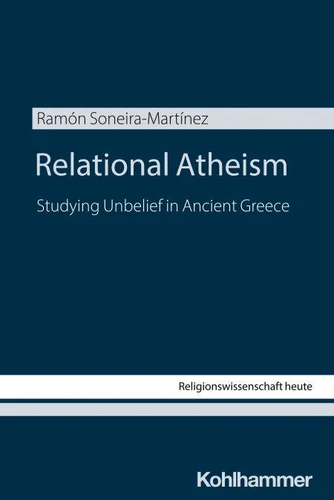
Relational Atheism. Studying Unbelief in Ancient Greece
Par : , , ,Formats :
Disponible dans votre compte client Decitre ou Furet du Nord dès validation de votre commande. Le format ePub est :
- Compatible avec une lecture sur My Vivlio (smartphone, tablette, ordinateur)
- Compatible avec une lecture sur liseuses Vivlio
- Pour les liseuses autres que Vivlio, vous devez utiliser le logiciel Adobe Digital Edition. Non compatible avec la lecture sur les liseuses Kindle, Remarkable et Sony
 , qui est-ce ?
Notre partenaire de plateforme de lecture numérique où vous retrouverez l'ensemble de vos ebooks gratuitement
Pour en savoir plus sur nos ebooks, consultez notre aide en ligne ici
C'est si simple ! Lisez votre ebook avec l'app Vivlio sur votre tablette, mobile ou ordinateur :

- Nombre de pages234
- FormatePub
- ISBN978-3-17-047188-7
- EAN9783170471887
- Date de parution04/03/2026
- Protection num.Digital Watermarking
- Taille8 Mo
- Infos supplémentairesepub
- ÉditeurKohlhammer
Résumé
This book reorients the study of 'unbelief' in Ancient Greece by dismantling two persistent scholarly misconceptions: the portrayal of Greek atheism as a form of proto-modern secularity and the dismissal of the subject as merely a lexical dispute over definitions. By integrating a diverse range of philosophical, medical and epigraphical sources, the author contextualises irreligious stances within the discursive and social ecology that shaped Greek religiosity.
Rather than representing an external negation of the divine, unbelief emerges as a historically specific modification of self-world relations. Leveraging relational sociology and contemporary Religious Studies, this analysis demonstrates how doubt, critique and denial took root within the fabric of lived ancient religion - from theatre and intellectual circles to civic conflict and the politics of impiety.
The result is a transformative account of Greek unbelief and a transferable analytical model for future comparative and historical research.
Rather than representing an external negation of the divine, unbelief emerges as a historically specific modification of self-world relations. Leveraging relational sociology and contemporary Religious Studies, this analysis demonstrates how doubt, critique and denial took root within the fabric of lived ancient religion - from theatre and intellectual circles to civic conflict and the politics of impiety.
The result is a transformative account of Greek unbelief and a transferable analytical model for future comparative and historical research.