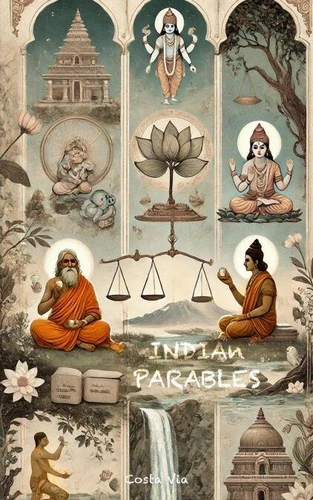
India's storytelling tradition has long used the parable - a short narrative carrying a lesson beneath its surface - to pass wisdom from teacher to student and generation to generation. This collection gathers parables drawn from across that tradition: stories associated with sages and seekers, teaching tales used by spiritual teachers to illustrate a single point of insight, and the shorter fables that have circulated in oral and written form throughout the subcontinent. Each parable is retold here in plain, accessible language, with brief reflections that draw out what the story is pointing toward without over-explaining it.
Themes recur across the collection: the difference between appearance and reality, the nature of the self, the value of a quiet mind, and the many small ways a seeker's own assumptions get in the way of what they are looking for. This is a book to read slowly. Its stories are short by design, meant to be read one at a time and sat with rather than consumed in sequence, and it will suit readers already familiar with Indian philosophy as well as newcomers meeting these teaching stories for the first time.
India's storytelling tradition has long used the parable - a short narrative carrying a lesson beneath its surface - to pass wisdom from teacher to student and generation to generation. This collection gathers parables drawn from across that tradition: stories associated with sages and seekers, teaching tales used by spiritual teachers to illustrate a single point of insight, and the shorter fables that have circulated in oral and written form throughout the subcontinent. Each parable is retold here in plain, accessible language, with brief reflections that draw out what the story is pointing toward without over-explaining it.
Themes recur across the collection: the difference between appearance and reality, the nature of the self, the value of a quiet mind, and the many small ways a seeker's own assumptions get in the way of what they are looking for. This is a book to read slowly. Its stories are short by design, meant to be read one at a time and sat with rather than consumed in sequence, and it will suit readers already familiar with Indian philosophy as well as newcomers meeting these teaching stories for the first time.

 , qui est-ce ?